Table of Contents
Conveyor system integration is the backbone of modern fulfillment, and conveyor system integration done right can unlock major wins in throughput, accuracy, and labor efficiency.

Conveyor system integration: Why Integration Matters Now
When order lines spike and SKUs proliferate, the gap between “installed hardware” and “a synchronized, data-driven flow” widens. Integration closes that gap by aligning conveyor hardware, sensors, scanners, PLC logic, HMIs, and host systems (WMS/ERP/WCS) into one orchestrated flow that can adapt to demand, exceptions, and SKU variability. Lafayette Engineering focuses on that orchestration—pairing robust conveyor controls, HMI design, and field-proven commissioning to translate business rules into predictable, safe motion across the entire line. LaFayette Engineering+1
Core Building Blocks of a Great Integration
1) Hardware and Layout Fundamentals
- Conveyor mix: belt for continuous flow, motor-driven roller (MDR) for accumulation and zone control, belt-over-roller for odd sizes, and sortation where needed.
- Merge/divert logic: right-angle transfers, pop-up wheel or slat sorters, narrow belt sorters, and properly timed merges that prevent starvation and blocking.
- Ergonomics & serviceability: guardrails, walk-unders, and maintenance access that reduce mean time to repair (MTTR).
Industry groups like MHI maintain deep primers on conveyor and sortation technologies; they’re great for aligning terminology and options across teams. See: MHI — Conveyor & Sortation Fundamentals. MHI.org
2) Controls Architecture (PLC + I/O + VFD/MDR)
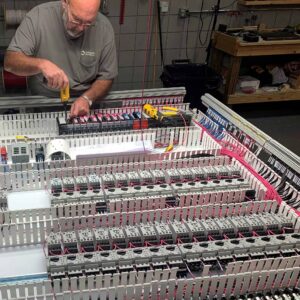
Robust PLC architectures (IEC 61131-3 languages) with modular function blocks let you standardize start/stop, jam detection, energy modes, diverter control, photo-eye handling, and alarms across zones. This standardization collapses commissioning time and simplifies troubleshooting long-term. Wikipedia
3) HMI That Drives Uptime
Operators need situational awareness fast: live device states, jam locations, queue depths, and guided recovery steps. ISA-101 guidance (alarm philosophy, navigation, color usage) helps avoid clutter while surfacing the right signals. See: ISA-101 HMI Standards. isa.org
4) Host System Handshakes (WMS/ERP/WCS)
Define each message/field and timing: carton inducted, weight/scan pass, reprint label, exception loop, destination assign, confirmation, close-manifest. Your conveyor controls layer translates these events into motion at millisecond scale so operators feel the system “just works.” Lafayette Engineering’s integration content highlights PLC/HMI/controls design as a core differentiator. LaFayette Engineering+1
A Phased Method That Works
- Discovery & Data: SKUs, order profiles, growth assumptions, exception types, seasonal peaks.
- Controls & Data Flow Design: define zones, naming, alarms, tag conventions, HMI pages, message schemas.
- Simulation/Emulation: reduce risk by testing logic and host messaging before steel is hot.
- Field Installation & FAT/SAT: structured I/O checklists, permissives/interlocks, safety validation.
- Ramp & Stabilize: tuning speed curves, divert timing, alarm thresholds; train operators on HMI workflows.
- Optimize: monitor choke points and re-time merges/sorters; add sensors or logic where data says to.
Safety Is Non-Negotiable
Guarding, nip-point protection, and emergency stops must be designed and validated early. OSHA’s 1910 standards outline guarding expectations for moving parts and power transmission—requirements that should be reflected in both mechanical design and controls interlocks. See: OSHA 1910.212/219 Machine Guarding. OSHA
KPIs to Track Post-Go-Live
- Throughput by hour/zone (with targets)
- Divert accuracy and NFF (no-fault-found) rates
- Jam rate & mean time to clear
- Energy profile (VFD/MDR idle vs. run)
- Labor productivity (cartons/hour per operator)
Why Lafayette Engineering
LEI’s recent content spotlights controls, HMI, and retrofit expertise—exactly the disciplines that make integration resilient over years, not just at go-live. If you’re planning a new line or modernizing an old one, you want a controls-first partner that designs for maintainability from day one. LaFayette Engineering+1
Ready to plan your next conveyor system integration? Let’s scope your data flows, safety logic, and HMI so your first day of peak feels like week 10.