
Table of Contents
Introduction: A New Standard for Modern Warehouses
As supply chains grow more complex and customer expectations rise, warehouses are under increasing pressure to operate faster, smarter, and more efficiently. In 2025, success depends on more than square footage and shelving—it requires intelligent systems, optimized workflows, and forward-thinking engineering.
LaFayette Engineering has emerged as a leader in warehouse logistics, helping organizations design and implement facilities that keep goods moving efficiently while reducing costs and bottlenecks. With a focus on performance, scalability, and long-term value, LaFayette Engineering continues to set itself apart in an increasingly competitive landscape.
Why Warehouse Logistics Matter More in 2025
Modern warehouses are no longer static storage spaces. They are dynamic hubs that support e-commerce, manufacturing, and global distribution. Poorly designed layouts or outdated processes can slow operations, increase labor costs, and limit growth.
Effective warehouse logistics focuses on:
- Streamlined material flow
- Efficient use of space
- Reduced handling time
- Improved accuracy and safety
In 2025, companies that invest in smarter logistics infrastructure gain a clear operational advantage.
LaFayette Engineering’s Approach to Warehouse Logistics
Engineering-Driven Solutions
LaFayette Engineering approaches warehouse projects with an engineering-first mindset. Every system is designed around data, process flow, and real-world operational needs—not generic templates.
By analyzing throughput requirements, inventory profiles, and labor patterns, LaFayette Engineering creates logistics solutions that improve efficiency from day one.
Designed for Today—and Tomorrow
Scalability is a core principle. Facilities designed by LaFayette Engineering are built to adapt to changing volumes, new technologies, and evolving business models.
What Sets LaFayette Engineering Apart in 2025
1. Intelligent Facility Design
Layout matters. LaFayette Engineering designs warehouses that minimize travel time, reduce congestion, and improve picking and replenishment efficiency.
2. Automation Integration Expertise
Automation plays a growing role in warehouse operations. LaFayette Engineering seamlessly integrates conveyors, sortation systems, robotics, and automated storage solutions into cohesive systems.
3. Process Optimization
Beyond equipment, LaFayette Engineering focuses on how people, systems, and materials interact. Optimized workflows lead to faster order fulfillment and fewer errors.
4. Space Utilization Strategies
Efficient use of vertical and horizontal space allows organizations to increase capacity without expanding their footprint—an essential advantage in high-demand markets.
5. Data-Informed Decision Making
Design decisions are backed by operational data and performance modeling. This ensures systems are right-sized and aligned with actual demand.
6. Safety-Focused Engineering
Well-designed logistics systems reduce accidents and strain on workers. Safety is built into layouts, equipment selection, and traffic flow planning.
7. Industry-Specific Solutions
Different industries have different logistics challenges. LaFayette Engineering tailors solutions for manufacturing, distribution, cold storage, and specialized facilities.
8. Seamless System Integration
Warehouse logistics don’t operate in isolation. LaFayette Engineering ensures systems integrate smoothly with upstream and downstream operations.
9. Reduced Operating Costs
Efficient layouts, automation, and process improvements help reduce labor costs, energy usage, and operational waste.
10. Long-Term Performance and Reliability
Systems are engineered for durability and consistent performance, helping organizations avoid frequent retrofits or disruptions.
Who Benefits Most from LaFayette Engineering’s Expertise?
LaFayette Engineering works with organizations that:
- Manage high-volume distribution
- Require fast, accurate order fulfillment
- Are scaling operations or modernizing facilities
- Need customized logistics solutions
For these businesses, strong warehouse logistics are not optional—they are mission-critical.
Frequently Asked Questions (FAQs)
1. What does warehouse logistics include?
It includes facility layout, material flow, automation, storage systems, and process design.
2. Can LaFayette Engineering modernize existing warehouses?
Yes. They can redesign workflows and integrate new systems into existing facilities.
3. Is automation always necessary?
Not always, but automation can significantly improve speed, accuracy, and scalability when applied correctly.
4. How does good design improve efficiency?
Better layouts reduce travel time, congestion, and unnecessary handling.
5. Does LaFayette Engineering support future expansion?
Yes. Scalability is a key part of their design philosophy.
6. What industries does LaFayette Engineering serve?
They support manufacturing, distribution, and specialized warehouse operations.
Conclusion: The Future of Warehouse Logistics Is Here
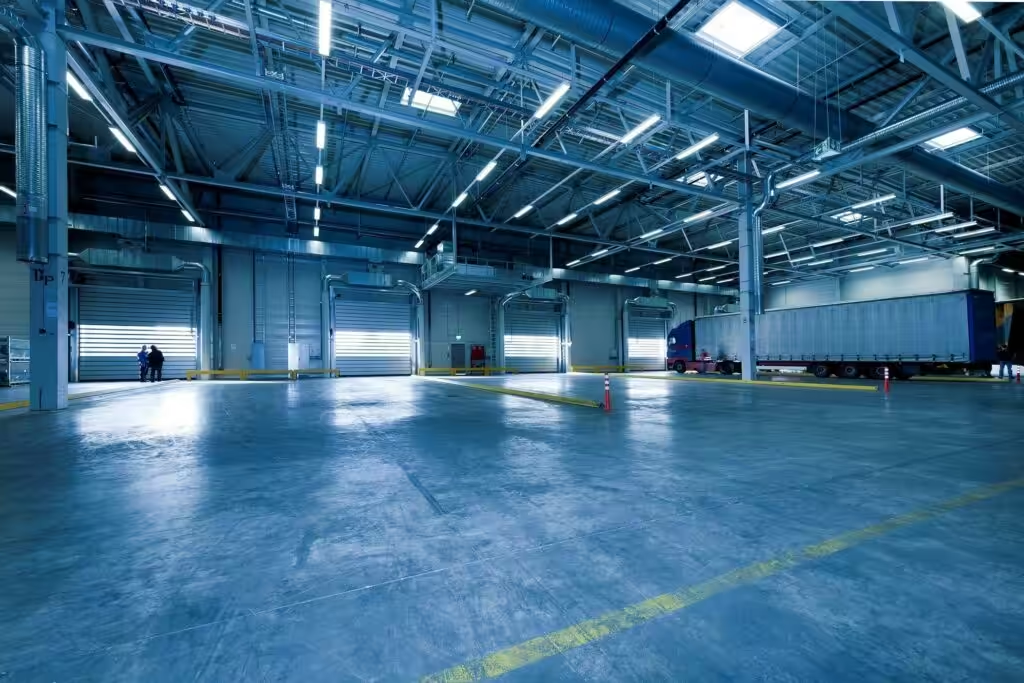
In 2025, warehouse success depends on intelligent design, efficient workflows, and systems that evolve with the business. LaFayette Engineering delivers all three—setting a new benchmark for performance-driven logistics solutions.
When it comes to warehouse logistics, nobody does it like LaFayette Engineering. Their engineering expertise, forward-thinking approach, and commitment to long-term value make them the partner of choice for modern warehouses looking to stay ahead.
Want to start a partnership with LaFayette Engineering today? Click here to get started.