Table of Contents
Simply put, a carton flow rack is a gravity-fed storage system that uses slightly inclined rollers or wheel tracks to automatically move cartons from a loading side toward a picking side. It works especially well in warehouses, distribution centers, and manufacturing facilities that need dense, organized storage with fast access to frequently picked products, particularly in first-in, first-out inventory applications.
What makes a Carton Flow Rack Special?
A carton flow rack is a dynamic storage system designed to make picking smaller cases, cartons, totes, and individual products faster and more organized.
Unlike conventional static shelving, where an employee places a carton on a shelf and another employee later retrieves it from essentially the same location, a flow rack has separate loading and picking sides.
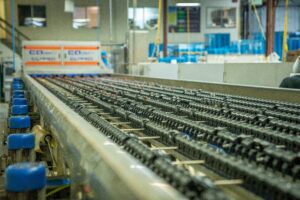
Products are loaded from the rear. Gravity then moves them forward along rollers or wheels until they reach the picking face. When an employee removes the front carton, the next one automatically advances.
The basic idea is remarkably simple, but when correctly engineered, it can have a significant impact on warehouse efficiency.
A typical system may include:
- Upright frames
- Inclined roller or wheel tracks
- Product lanes
- Guides
- End stops
- Adjustable shelf levels
The exact configuration depends on carton dimensions, weights, inventory characteristics, and operational requirements.
How Does Carton Flow Rack Work?
The system relies primarily on gravity.
Each storage lane is installed with a slight downward slope from the loading side toward the picking side. Employees or material-handling equipment replenish products from the higher end.
Once a carton is placed in the lane, gravity moves it toward the front.
The sequence is straightforward:
- A product is loaded into the rear of the lane.
- Gravity moves it toward the picking face.
- The front carton reaches its designated stopping position.
- An employee picks that carton.
- The next carton automatically moves forward.
- The process repeats.
Because the inventory advances automatically, employees don’t need to reach deep into shelving to find the next carton.
That can create a cleaner, more consistent picking process.
Carton Flow Rack and FIFO Inventory
One of the biggest reasons businesses consider carton flow is its natural compatibility with first-in, first-out—or FIFO—inventory management.
With FIFO, the oldest inventory is generally picked before newer inventory.
A carton flow rack supports this process because replenishment occurs from one side while picking occurs from the opposite side.
New inventory is loaded behind existing inventory rather than placed directly in front of it.
FIFO can be particularly useful for products with:
- Expiration dates
- Lot considerations
- Date-sensitive packaging
- Frequent inventory turnover
However, businesses shouldn’t assume that installing flow rack automatically guarantees perfect inventory rotation. Employees still need appropriate replenishment procedures, labeling, and inventory controls.
The equipment supports good processes; it doesn’t replace them.
Where Does Carton Flow Rack Fit Best?
Carton flow systems are especially useful in operations where employees repeatedly pick cartons, cases, or individual items from forward-facing inventory locations.
Common applications include:
- Distribution centers
- E-commerce fulfillment
- Manufacturing facilities
- Parts storage
- Order-picking operations
- Assembly areas
- Warehouses
- Retail distribution
A carton flow rack can also work well in pick modules where multiple storage and conveyor technologies are combined into one fulfillment system.
The best application is typically one where product movement is frequent enough to justify dynamic storage.
For very slow-moving inventory, conventional shelving may sometimes be simpler and more economical.
How Carton Flow Can Improve Picking Efficiency
Travel and search time can represent a significant portion of warehouse labor.
Workers may spend time:
- Walking between storage locations
- Reaching into shelves
- Searching for the correct SKU
- Moving empty cartons
- Reorganizing inventory
A well-designed carton flow rack can reduce some of this nonproductive movement by presenting products consistently at the front of the rack.
Instead of reaching deep into storage, employees pick from an accessible face.
This can be particularly valuable in high-volume operations where a small improvement is repeated thousands of times during a shift.
The actual productivity gain depends on the facility, product mix, picking method, and system design. Engineering analysis should therefore evaluate real operational data rather than assuming a particular percentage improvement.
Storage Density Is Another Potential Advantage
Warehouses constantly face a difficult question: how can more inventory be stored without making products harder to access?
Carton flow can provide an effective balance.
Multiple cartons of the same SKU can be stored one behind another in a relatively compact lane. Because inventory replenishment happens from the rear, employees don’t need to move newer cartons out of the way to access older stock.
This can improve storage density while preserving an organized picking face.
The amount of improvement depends on:
- Carton dimensions
- Rack depth
- Lane configuration
- SKU quantities
- Available ceiling height
- Replenishment strategy
Simply making lanes deeper isn’t always better. Excessive depth can create unnecessary inventory at the pick face and make replenishment more complicated.
The system needs to be designed around actual demand.
Separating Picking and Replenishment Traffic
One particularly useful feature of carton flow is the separation between picking and replenishment.
Pickers work from one side while replenishment occurs from the other.
This can reduce interference between employees performing different tasks.
In a conventional shelving arrangement, the person restocking inventory may occupy the same aisle as the employee trying to pick it.
With a carton flow rack, those activities can potentially occur on separate sides.
Depending on the overall facility design, this separation may help:
- Reduce congestion
- Simplify workflows
- Improve organization
- Support safer traffic patterns
This benefit becomes especially important in high-volume fulfillment environments.
Carton Flow Rack vs. Static Shelving
Static shelving is simple and useful. It remains the correct solution for many applications.
So why choose carton flow?
The answer depends on inventory velocity and operational goals.
| Feature | Carton Flow Rack | Static Shelving |
|---|---|---|
| Product movement | Gravity-fed | Manual |
| Loading/picking | Separate sides | Usually same side |
| FIFO support | Strong | Requires more manual control |
| Pick-face presentation | Automatic | Manual |
| Best use | Medium/high velocity | Low/variable velocity |
| System complexity | Higher | Lower |
Static shelving may be appropriate for slow-moving products or operations where simplicity is more important than picking speed.
Carton flow becomes more attractive when the operational value of faster, more organized picking justifies the additional system complexity.
What Products Work Well in Carton Flow?
Product characteristics matter enormously.
Good candidates may include:
- Consistently sized cartons
- Totes
- Cases
- Parts containers
- Packaged goods
Engineers need to consider factors such as:
- Weight
- Width
- Length
- Bottom surface
- Stability
- Packaging strength
A carton with a smooth, rigid bottom may travel differently from a soft or irregular package.
Extremely light products may not always flow as expected, while unusually heavy loads can require different components.
Testing representative products before finalizing a system can be valuable.
The Importance of Lane Design
A carton flow rack isn’t simply shelving tilted forward.
The lane needs to be engineered around the products it will handle.
Important considerations include:
- Lane width
- Lane depth
- Track spacing
- Slope
- Product weight
- Carton dimensions
- Required capacity
If lanes are too narrow, products may bind. If they are too wide, cartons may become misaligned.
The slope also matters.
Too little incline may prevent products from advancing reliably. Too much can cause them to move too aggressively.
Proper design creates controlled, predictable movement.
Ergonomics Can Improve the Picking Experience
Warehouse efficiency isn’t only about how fast equipment moves.
Employee movement matters too.
A properly configured picking area can reduce unnecessary reaching, bending, and searching.
Fast-moving products can potentially be positioned within comfortable picking zones, while slower-moving SKUs can occupy less convenient locations.
LaFayette Engineering can evaluate how rack height, picking positions, conveyors, workstations, and surrounding equipment interact.
This complete-system perspective is important because a carton flow rack may be efficient by itself while still being poorly positioned within the larger operation.
Carton Flow and Conveyor Systems
Flow rack is often used alongside conveyors.
For example, an employee may pick products from carton flow and place completed orders or containers onto a conveyor positioned nearby.
This can create a streamlined process:
Storage → Picking → Conveyor → Packing/Sortation/Shipping
The exact arrangement depends on the facility.
Engineers should consider:
- Picker movement
- Conveyor height
- Replenishment access
- Order container placement
- Traffic patterns
- Emergency access
Good integration reduces unnecessary handling.
Poor integration can create congestion even when the individual equipment performs correctly.
Carton Flow Rack and Warehouse Automation
Carton flow isn’t necessarily a fully automated technology, but it can complement automation extremely well.
A modern facility might combine it with:
- Pick-to-light systems
- Barcode scanning
- Conveyors
- Automated sortation
- Warehouse software
- Robotics
For example, pick-to-light technology can direct an employee to the correct flow lane and indicate the required quantity.
The employee picks from an automatically presented carton, confirms the task, and moves to the next location.
This combination can create a highly organized semi-automated picking process without requiring a robot for every movement.
When Carton Flow May Not Be the Best Choice
Carton flow has advantages, but it isn’t appropriate for every operation.
Another storage method may be preferable when:
- Inventory moves very slowly
- Carton dimensions vary dramatically
- Products have unstable packaging
- SKU quantities are extremely small
- Replenishment access is limited
- The facility changes product mix constantly
Businesses should avoid installing technology simply because it sounds more advanced.
The right storage solution is the one that fits the actual operation.
LaFayette Engineering can help clients compare alternatives based on throughput, inventory, available space, labor, and future growth.
Common Carton Flow Rack Design Mistakes
Several mistakes can limit performance.
Ignoring Product Testing
Assuming every carton will flow correctly can create problems after installation.
Using the Wrong Lane Width
Poor lane sizing may cause binding or product misalignment.
Ignoring Replenishment
A great picking system can still perform poorly if restocking is difficult.
Overloading the Pick Face
Too much inventory can waste space and reduce flexibility.
Ignoring Ergonomics
Fast-moving products should be positioned with employee movement in mind.
Forgetting Future SKU Changes
Warehouse inventory evolves, so adjustability can be valuable.
Good engineering addresses these questions before equipment is installed.
How Do You Know If You Need Carton Flow Rack?
Several operational symptoms may indicate that carton flow deserves consideration.
Ask whether your facility experiences:
- High-volume carton or case picking
- Excessive walking or reaching
- Difficulty maintaining FIFO
- Congestion between pickers and replenishment teams
- Poor use of available storage depth
- Disorganized forward-pick locations
- Growing fulfillment volume
If several of these conditions exist, a carton flow rack may provide a useful solution.
That doesn’t mean it should automatically be installed. A broader material-flow study can determine whether rack changes, conveyor modifications, slotting improvements, or another technology would provide greater value.
How LaFayette Engineering Can Help
Warehouse storage doesn’t operate in isolation.
Racking interacts with:
- Conveyors
- Employees
- Forklifts
- Automation
- Inventory systems
- Packing areas
- Shipping
- Facility layouts
LaFayette Engineering can help businesses evaluate the entire operation before selecting a solution.
That can include analyzing:
- SKU velocity
- Product dimensions
- Storage requirements
- Material flow
- Picking methods
- Replenishment
- Ergonomics
- Future capacity
This engineering-first approach helps clients avoid purchasing equipment before understanding the underlying operational need.
The objective isn’t simply to install a carton flow rack. It is to create a material-handling system that makes the entire facility work better.
Frequently Asked Questions
1. What is a carton flow rack?
A carton flow rack is a gravity-fed storage system that automatically moves cartons or totes from a rear loading position toward a forward picking position.
2. How does carton flow rack work?
Products travel along slightly inclined rollers or wheel tracks using gravity. When the front carton is removed, the next carton moves forward.
3. Does carton flow support FIFO inventory?
Yes. Because new inventory is generally replenished from the rear while older inventory is picked from the front, the design naturally supports FIFO processes when used correctly.
4. What products work best in carton flow?
Consistently sized cartons, totes, cases, and parts containers are common applications, although product dimensions, weight, and packaging should be evaluated.
5. Is carton flow better than static shelving?
Not universally. Carton flow can be advantageous for medium- and high-velocity picking, while static shelving may be more appropriate for slower-moving or highly variable inventory.
6. How can LaFayette Engineering help with carton flow?
LaFayette Engineering can evaluate storage, product flow, conveyors, picking processes, facility layout, ergonomics, and automation to determine how carton flow should fit within the wider operation.
Conclusion: Simple Gravity Can Create Smarter Material Flow

A carton flow rack is a deceptively simple technology. Products are loaded from one side, gravity carries them toward the picking face, and the next carton automatically advances whenever the front one is removed.
But the operational possibilities go much further.
When properly engineered, carton flow can support FIFO inventory, reduce unnecessary reaching, separate picking from replenishment, improve storage density, and create more organized high-volume fulfillment processes.
The key is choosing and designing the system correctly.
Product characteristics, throughput, lane dimensions, replenishment, ergonomics, conveyors, automation, and future growth all need to be considered before installation.
LaFayette Engineering can help businesses examine those factors as parts of one complete material-handling system.
For facilities struggling with inefficient picking, crowded storage, or growing fulfillment demands, a properly designed carton flow rack may be a simple idea capable of delivering a much smarter operation.
Interested in learning more? Contact LaFayette Engineering here to get started.