A cross belt sorter is a loop of carriers, each with its own short belt conveyor mounted at a right angle to the direction of travel, that discharges an item by running that belt at the moment the carrier reaches the item’s destination. It is one of six sorter types in common use, alongside the sliding shoe, tilt-tray, push tray, bomb-bay, and narrow belt sorter, and each one moves product to a destination in a different way.
Picking between them is one of the largest decisions in a distribution center design, and it is hard to reverse. The sorter sets which products the building can handle automatically, how many destinations fit in the footprint, how the induction is staffed, and what maintenance will look like for years after start-up. This guide compares the major sorter types from the point of view of the people who have to run them: what each one does well, where each one struggles, and how the controls and the warehouse control system (WCS) shape the result.
At a glance
- A cross belt sorter discharges items by running a small belt on each carrier. It handles a wide product mix, including polybags and small items, and fits many destinations in a loop.
- A sliding shoe sorter pushes cartons off at an angle with a diagonal line of shoes. It remains the standard for cases and cartons of varied size.
- Tilt-tray sorters tip a tray to slide the item into a chute. Bomb-bay sorters open doors in the bottom of the tray and drop the item into a destination below.
- Push tray and narrow belt sorters fill narrower roles; the narrow belt design handles cartons with right-angle or angled transfers.
- Product mix, destination count, footprint, and induction method decide the sorter type far more often than rated speed does.
- Every sorter type depends on the same controls chain: identification, a destination from the WCS, tracking, a divert command, and confirmation.
Table of Contents
What Every Sorter Has in Common
Every sorter does the same job: take a stream of mixed product and send each item to the destination it belongs in, usually an outbound lane, a store, an order, or a shipping door. LaFayette Engineering’s sortation solutions page puts it simply: sortation systems separate products for induction into individual lanes typically associated with an outbound destination.
The mechanical divert is what distinguishes one sorter type from another. The decision behind the divert is the same on all of them:
- Induction. Product enters the sorter, either onto a moving conveyor at a controlled gap or onto a specific carrier or tray.
- Identification. A scanner or scan tunnel reads the barcode. Some systems also capture weight and dimensions here.
- Destination. The WCS looks up where that item belongs and passes the destination to the PLC.
- Tracking. The PLC knows where the item is at every moment, either by counting encoder pulses along a conveyor or by knowing which carrier the item is riding on.
- Divert. At the destination, the PLC fires the divert: a switch, a carrier belt, a tilting tray, a pusher, or a door.
- Confirmation and exceptions. Sensors confirm the item left, and no-reads, items with no destination, and full destinations go to a reject or recirculation path.
When an operation says “the sorter missorted,” the problem is just as likely to be in steps 1 through 4 as in the divert itself. That matters when comparing a cross belt sorter with a shoe sorter or a tilt-tray, because a sorter with a gentler or faster divert will not fix a poor read rate or a WCS that answers too slowly.

How a Cross Belt Sorter Works
The problem it solves: e-commerce and store-ready fulfillment changed what sorters carry. LEI’s sortation page describes the shift from transporting cases for store replenishment to handling individual items and packaging types, including cases, totes, and polybags. Many of those items do not present a flat, stable face to a shoe, and many are too small or light to divert reliably by pushing.
How it diverts: a cross belt sorter carries each item on its own carrier. Each carrier has a short belt that runs at a right angle to the sorter’s direction of travel. Items are inducted onto the cross belt sorter’s empty carriers, and the controls record which carrier holds which item. When that carrier reaches the item’s destination, its belt runs and moves the item sideways off the carrier into a chute, a bag, a tote, or a takeaway conveyor. Most cross belt sorters can discharge to either side.
What a cross belt sorter does well:
- Wide product mix. Polybags, small boxes, soft goods, and items with irregular shapes ride on a flat belt and leave under control. The belt can be run in both directions, which helps position an item on the carrier before discharge.
- Many destinations in a small space. Because a cross belt sorter runs as a loop, destinations can line both sides along its full length. Operations that sort to hundreds of orders, stores, or routes often look at a cross belt sorter for that reason.
- Natural recirculation. An item a cross belt sorter cannot discharge, because its destination is full or its barcode didn’t read, simply stays on the carrier and goes around again.
- Controlled discharge. A belt carries the item off the carrier, so the discharge can be tuned to item size and weight.
Where a cross belt sorter is a weaker fit:
- Large or heavy cases may exceed what a cross belt sorter’s carrier can carry, and long items can span more than one carrier.
- Induction usually has to place each item onto a carrier, which adds staffing at manual induction stations or requires automated induction.
- A cross belt sorter has many carriers, and every carrier has a belt and a drive that must be powered and controlled. That is more moving equipment per destination than a shoe sorter, so the maintenance plan has to account for it.
Sliding Shoe Sorters
How it diverts: a sliding shoe sorter is a slat conveyor where each slat carries a sliding shoe. At each lane, a divert switch steers pins under the slats onto a diagonal track, and the shoes slide across the bed in a staggered line that pushes the carton off at an angle onto a takeaway lane.
Where it fits: cartons and cases of varied size, especially in parcel, retail replenishment, and outbound shipping sortation. The divert is gentle and keeps the carton oriented, and the equipment is well understood by maintenance teams.
Where it struggles: very small items, polybags that do not give the shoes a stable face, and sortation to a very large number of small destinations.
The shoe sorter has its own guide on LEI’s blog. Sliding Shoe Sorters: How They Divert, Where They Wear, and What Can Be Retrofitted covers the divert sequence, the six places a shoe sorter wears, and what can be upgraded while the sorter stays in place, including the divert switch.
Tilt-Tray Sorters
How it diverts: a tilt-tray sorter carries each item on a tray. At the destination, the tray tilts to one side and the item slides off into a chute. Like a cross belt sorter, it runs as a loop, so destinations can line both sides and items that miss their destination recirculate.
Where it fits: a broad range of small and medium items that can tolerate a short slide, sorted to many destinations. Tilt-tray sorters are common in unit sortation, returns, and store or order consolidation, and they often compete with a cross belt sorter for the same work.
Where it struggles: items that roll, items that are fragile enough that a slide into a chute is a risk, and items whose shape makes the slide unpredictable. Because gravity does the discharge, the item’s position and friction on the tray affect where it lands. Compared with a cross belt sorter, the discharge is less controlled. Compared with a bomb-bay sorter, it uses more floor width per destination, because chutes run out to the sides.
Bomb-Bay Sorters
How it diverts: a bomb-bay sorter carries each item on a tray or in a pocket with doors in the bottom. At the destination, the doors open and the item drops straight down into a bag, tote, or chute below the sorter.
Where it fits: small, light items such as apparel, polybags, and small parcels, sorted to a large number of destinations in a compact footprint. Because destinations sit underneath the sorter instead of beside it, as they do on a cross belt sorter, a bomb-bay layout can pack many destinations into a short length.
Where it struggles: heavy, rigid, or fragile items that do not tolerate a drop, and cartons too large for the tray. Clearing destinations under the sorter also has to be designed carefully, because people and carts need safe access to the bags or totes while the sorter runs.
Push Tray and Narrow Belt Sorters
Push tray sorters carry items on trays and push them off at the destination. They sit between tilt-tray and shoe designs: the item rides on a tray like a loop sorter but is moved off by a mechanism instead of gravity. LEI lists push tray sorters among the sorter types on its sortation solutions page.
Narrow belt sorters convey cartons on a series of narrow belts and divert them with transfers that rise between the belts at the destination, either at a right angle or at an angle. They suit cartons and totes at moderate rates, and the right-angle version can divert to lanes in a short footprint. They don’t compete with a cross belt sorter for small items or polybags. LEI’s Pitman Creek success story includes a right-angle narrow belt on a fishing tackle distributor’s new facility, in a system built on an Allen-Bradley PLC and the ConveyorWorks WCS.
Cross Belt Sorter vs. Shoe, Tilt-Tray, and Bomb-Bay: Side by Side
The table below compares the four types buyers ask about most. It is a qualitative comparison. Rates, item limits, and destination counts depend on the specific equipment and design, so treat any rated number as something to confirm against your own product data.
| Cross belt sorter | Sliding shoe sorter | Tilt-tray sorter | Bomb-bay sorter | |
|---|---|---|---|---|
| How it diverts | Carrier belt runs sideways | Shoes push carton off at an angle | Tray tilts, item slides | Doors open, item drops |
| Layout | Loop | Linear | Loop | Loop |
| Typical product | Wide mix, including polybags and small items | Cartons and cases of varied size | Small and medium items that can slide | Small, light items and polybags |
| Destinations | Many, both sides | Lanes along one or both sides | Many, both sides | Many, below the sorter |
| Handling | Controlled, belt-driven | Gentle, keeps orientation | Gravity slide | Gravity drop |
| Recirculation | Built in | Needs a recirculation path | Built in | Built in |
| Induction | Onto a carrier | Onto a gapped conveyor | Onto a tray | Onto a tray or pocket |
How to Choose: Five Questions That Decide the Sorter
Rated speed gets a lot of attention in sorter conversations, but it rarely decides the right answer. These five questions usually do.
1. What does the product mix look like, and how will it change?
The problem: a sorter chosen for today’s product can be wrong in three years. An operation that ships cartons now and adds polybag or each-pick fulfillment later can end up with a sorter that can’t handle the new work, and the new product goes to manual sortation.
The engineering answer: build the decision on real product data: dimensions, weights, packaging types, and the share of each. Include the items that cause trouble today. A cross belt sorter covers the widest mix, a shoe sorter covers cartons best, and a mixed operation may need more than one sorter type.
2. How many destinations, and how often do they change?
The problem: destination count drives footprint. A shoe sorter with a few dozen lanes is a very different building layout from a loop sorter with hundreds of chutes or bags.
The engineering answer: count destinations at peak, not on an average day, and decide whether destinations are fixed (doors, routes) or dynamic (orders, stores, waves). Loop sorters such as a cross belt sorter, tilt-tray, or bomb-bay suit high, dynamic destination counts. Linear sorters suit fewer, fixed lanes.
3. How will product be inducted?
The problem: induction is where many sorters lose rate. If cartons arrive bunched, or operators can’t keep carriers filled, the sorter runs below its design rate no matter how fast it moves.
The engineering answer: design induction and merge as part of the sorter from the first layout. A shoe sorter needs a merge and gapping section that delivers consistent gaps. A cross belt sorter needs induction stations, manual or automated, that place items onto empty carriers at a steady pace. Tight, consistent gaps and a merge that works often matter more to a sorter’s rate than belt speed.
4. What will maintenance look like?
The problem: every sorter type wears in its own places. A shoe sorter’s divert switches, shoes, pins, and slats see the most wear. A cross belt sorter or other loop sorter has many carriers or trays, each with moving parts that need inspection and spares.
The engineering answer: ask for the wear parts list and inspection schedule before choosing, and make sure the controls report problems by location, so maintenance can find a failing carrier, tray, or lane switch from the HMI instead of by walking the loop.
5. How will the sorter talk to the rest of the building?
The problem: a sorter is only as accurate as the destination it receives. If the WCS can’t answer in time, or the interface to the warehouse management system (WMS) is fragile, the sorter recirculates or rejects product it could have sorted.
The engineering answer: treat the WCS and the PLC tracking as part of the sorter specification. Decide early who owns the destination logic, how exceptions are handled, and what data the sorter reports back.

The Controls Behind Each Sorter Type
The differences between sorter types show up clearly in the controls.
Linear sorters (shoe and narrow belt) track items along a conveyor. A photo eye sees the leading edge, and the PLC counts encoder pulses as the item moves. When the item’s tracked position reaches its lane, the PLC fires the divert. Tracking accuracy depends on clean photo eyes, a healthy encoder, and consistent gaps. On a shoe sorter, the PLC also decides how many slats the switch fires for, based on item length.
Loop sorters (cross belt, tilt-tray, bomb-bay, push tray) track carriers. Every carrier or tray has a position in the loop, and at induction the controls assign an item to a carrier. From then on, the PLC tracks the carrier, not the item. When that carrier reaches the destination, the PLC commands the discharge for that one carrier. On a cross belt sorter, that means running one carrier belt at the right moment, and the discharge timing can also account for where the item sits on the carrier and how large it is.
Every sorter needs exception handling that operators trust. No-reads, no-destination items, full destinations, and failed discharges need clear rules and clear HMI reporting. A sorter that hides its exceptions looks fine until a shift ends with a pile of product at the reject lane and nobody knows why.
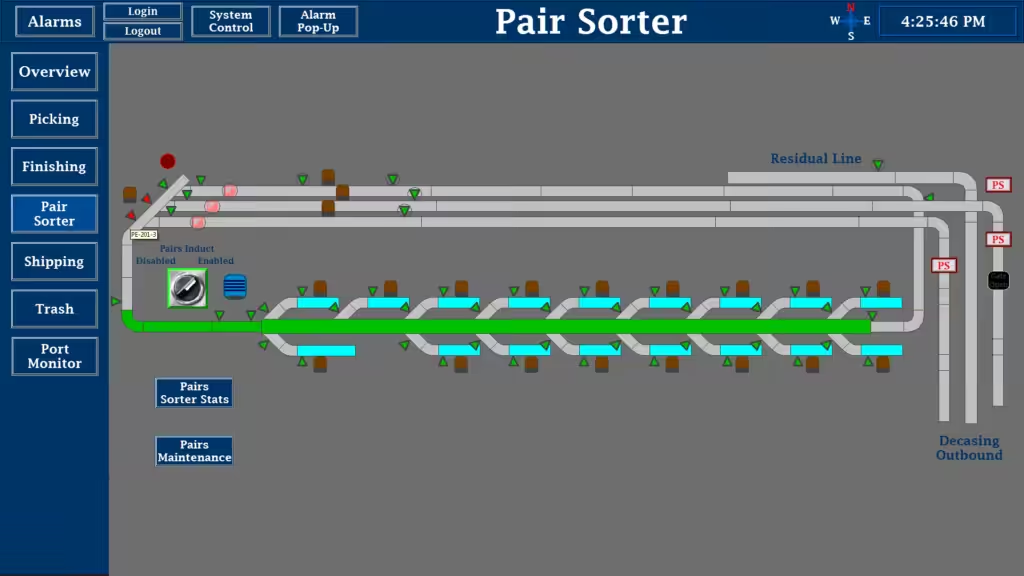
Every sorter needs data. An HMI that reports missorts, recirculation, destination-full events, and rate by destination and by shift turns a sorter’s performance into something the team can manage. LEI’s HMIs include alarm summary, alarm database, and alarm report screens for that reason.
Mixed Sorter Systems: When One Type Isn’t Enough
Many operations don’t fit one sorter, whether it’s a shoe sorter or a cross belt sorter. Cartons and polybags often arrive together, and each sorts best on different equipment.
LEI’s East Coast success story is a published example. In early 2021, LEI was asked to provide a new system for a facility designed for 260,000 cartons per day, including cartons and polybags. LEI partnered with Eurosort for polybags and Hytrol for cartons, captured weights, dimensions, and barcodes from receiving onward, and installed its LMS magnetic divert switch on the outbound sorters for faster response. LEI’s ConveyorWorks team worked with the customer’s WMS to track each carton and polybag to its correct outbound destination. The facility opened in time for peak and shipped 266,000 cartons per day in its first month.
The lesson for a sorter comparison is that the right answer can be two technologies under one WCS, such as a shoe sorter for cartons and a cross belt sorter or another loop sorter for polybags. When that happens, the controls architecture matters even more. Both sorters need consistent identification, one source of destinations, and reporting that shows the whole flow from induction to outbound destination.
Safety Across Sorter Types
Every sorter type has its own hazards: pinch points at the shoes and switches of a shoe sorter, moving carriers and discharge areas on a cross belt sorter, tilting trays and chute access on a tilt-tray sorter, and access to destinations under a bomb-bay sorter. Guarding, emergency stops, and safe access to destinations need to be part of the design from the start.
ASME B20.1, the safety standard for conveyors and related equipment, applies to sorters as it does to other conveyors. Servicing any sorter also falls under your site’s energy control procedure. This article is general information, not engineering or safety advice. Your equipment manufacturer and site safety team have the final word on any specific system.
Retrofit or Replace: Comparing Sorters You Already Own
Many sorter comparisons start with an existing sorter that no longer keeps up. Before choosing a new sorter type, separate what’s wrong with the current one:
- Is it a mechanical problem? On a shoe sorter, worn divert switches are a common cause of missorts and lane outages. Switches can often be replaced lane by lane. LEI’s LMS is an electromagnetic divert switch that works in new systems or, with minor adjustments, drops into existing Hytrol sortation, and it is rated for speeds up to 725 feet per minute.
- Is it a controls problem? Tracking drift, an aging PLC platform, or slow destination responses can make a sound sorter perform badly. These can be fixed without touching the mechanical sorter.
- Is it a product problem? If the product mix has moved to polybags and small items, a shoe sorter may be the wrong machine, and adding a cross belt sorter or another loop sorter for those items may be the better path.
- Is it an induction or merge problem? If the sorter starves or bunches, the fix is upstream.
Only the third question usually calls for a different sorter type. The others are often solved in the controls, the merge, or the divert.
How LaFayette Engineering Approaches Sortation
LaFayette Engineering designs and installs controls for conveyor systems, including high-speed case sortation. LEI lists cross-belt, sliding shoe, tilt-tray, push tray, and bomb-bay sorters among the sorter types on its sortation solutions page, and it works from the controls out: the PLC logic that tracks every item, the panels and field wiring, the HMI that shows what each destination is doing, the ConveyorWorks warehouse control system that assigns destinations and talks to the WMS, and, on shoe sorters, the LMS divert switch.
LEI uses open, non-proprietary components and programming architectures, with components from recognized manufacturers so spares are available locally. On a sortation system that runs every day, that keeps the controls supportable long after start-up.
If you’re weighing a cross belt sorter against other sorter types for a new building or deciding what to do with one you already own, start with LEI’s sortation solutions and talk through your product mix and destinations with the team.
Frequently Asked Questions
What is a cross belt sorter?
A cross belt sorter is a loop of carriers, each with a short belt that runs at a right angle to the direction of travel. When a carrier reaches an item’s destination, its belt runs and moves the item sideways into a chute, bag, or tote.
What is the difference between a cross belt sorter and a tilt-tray sorter?
Both run as loops with many destinations. A cross belt sorter moves the item off the carrier with a belt, so the discharge is controlled. A tilt-tray sorter tips the tray and lets the item slide off, so the discharge depends on gravity and on how the item sits on the tray.
What is a bomb-bay sorter?
A bomb-bay sorter carries items on trays or in pockets with doors in the bottom. At the destination, the doors open and the item drops into a bag, tote, or chute below the sorter. It suits small, light items sorted to many destinations in a compact footprint.
Which sorter is best for polybags?
Polybags usually sort better on a cross belt sorter, a tilt-tray sorter, or a bomb-bay sorter than on a shoe sorter, because they don’t present a stable face for shoes to push. The best choice depends on bag size and weight, destination count, and footprint.
Which sorter is best for cartons?
Sliding shoe sorters remain the standard for cartons and cases of varied size, because the angled divert is gentle and keeps cartons oriented. Narrow belt sorters also handle cartons and totes at moderate rates.
Does a faster sorter ship more?
Not always. A sorter’s rate often depends more on consistent gaps, induction that keeps carriers or lanes fed, a merge that works, and read rates at the scanner than on belt speed. Speed helps only when the rest of the system can keep up, and that holds for a cross belt sorter as much as a shoe sorter.
Can one facility use more than one sorter type?
Yes. Many facilities pair a shoe sorter for cartons with a loop sorter for polybags and small items. LEI’s East Coast project used Hytrol for cartons and Eurosort for polybags, with ConveyorWorks tracking both to the correct outbound destination.
Can an existing shoe sorter be upgraded instead of replaced?
Often, yes. Divert switches, PLC controls, tracking, HMI, and the WCS can usually be upgraded while the sorter frame and lanes stay in place. Replacement makes sense when the product mix has changed beyond what the sorter can handle or the mechanical platform can no longer be supported.