Table of Contents
Warehouse automation is the use of equipment, software, and control systems to perform or assist with warehouse tasks such as moving products, managing inventory, picking orders, sorting packages, and preparing shipments. For mid-size operations, warehouse automation means finding practical ways to reduce repetitive work, improve accuracy, and increase productivity without investing in technology that is unnecessarily expensive or complicated.
Warehouse Automation Doesn’t Have to Be Complicated
Warehouse automation has become one of the most discussed topics in manufacturing, distribution, and logistics. From robotic picking systems to sophisticated conveyor networks, new technologies promise to transform how products move through modern facilities.
However, for mid-size operations, these conversations can sometimes create more confusion than clarity.
Does every warehouse need robots? Is automation only practical for massive distribution centers? How much technology is actually necessary to improve productivity? And perhaps most importantly, how can businesses avoid investing in expensive systems that don’t solve their real operational problems?
These are important questions.
LaFayette Engineering understands that successful automation begins with practical engineering rather than technology trends. A system should be designed around the needs of the facility, its employees, its products, and its long-term business goals.
For companies considering warehouse automation in 2026, the objective should not be to build the most technologically impressive facility. It should be to create an operation that works more efficiently, consistently, and reliably.
This guide explains the fundamentals, explores common technologies, and identifies what mid-size businesses should consider before investing.
What Does Warehouse Automation Actually Include?
Automation covers a wide range of technologies, from relatively simple equipment to highly sophisticated robotic systems.
Common examples include:
- Conveyor systems
- Automated sortation equipment
- Barcode scanning
- Warehouse management software
- Automated storage and retrieval systems
- Autonomous mobile robots
- Automated guided vehicles
- Pick-to-light systems
- Packaging automation
- Inventory tracking technology
Not every facility needs all these technologies.
In fact, many mid-size warehouses can achieve meaningful improvements by automating only a few specific processes.
For example, installing a conveyor between picking and packing areas may eliminate substantial manual transportation without requiring an entirely robotic warehouse.
The key is identifying where automation creates practical value.
Why Mid-Size Warehouses Are Considering Automation
Mid-size facilities often face a unique set of operational challenges.
They may process enough inventory to experience congestion and labor inefficiencies but lack the budgets or physical space associated with enormous distribution centers.
Common challenges include:
- Increasing order volume
- Labor availability
- Rising operating costs
- Limited floor space
- Repetitive material handling
- Inventory accuracy
- Seasonal demand fluctuations
- Growing customer expectations
These pressures can make warehouse automation attractive.
However, automation should be viewed as a tool for addressing specific challenges rather than a universal solution.
The right system depends on the facility’s products, throughput, available space, and operating requirements.
Start With the Problem, Not the Technology
One of the most common mistakes businesses make is selecting automation equipment before fully understanding their operational needs.
A company may become interested in robotics because competitors are adopting them. Another may consider a large conveyor system because it appears more efficient than manual handling.
But neither investment automatically improves operations.
Before selecting equipment, businesses should ask:
- Where are employees spending unnecessary time?
- Which processes create recurring bottlenecks?
- What causes order errors?
- Where does material flow become congested?
- Which tasks are repetitive?
- What volume must the facility handle?
LaFayette Engineering approaches industrial improvements from this practical perspective.
Understanding the problem first allows businesses to select technologies that address real needs.
Conveyor Systems: A Practical Starting Point
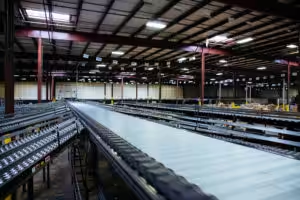
Conveyors are among the most established forms of warehouse automation.
They move cartons, totes, packages, or other materials between different areas of a facility.
Common conveyor technologies include:
- Belt conveyors
- Powered roller conveyors
- Gravity conveyors
- Accumulation conveyors
- Chain conveyors
- Sortation systems
For mid-size operations, conveyors can reduce the need for employees to repeatedly carry or transport products between workstations.
For example, a warehouse may install a conveyor connecting picking, packing, and shipping.
Instead of manually moving every completed order, employees can place cartons onto the conveyor for transportation.
This relatively straightforward improvement can support more consistent material flow.
However, conveyor design must account for product dimensions, throughput, facility layout, and downstream capacity.
Automated Storage and Retrieval Systems
Automated storage and retrieval systems, commonly called AS/RS, use automated equipment to place products into storage and retrieve them when needed.
These systems may include:
- Shuttle systems
- Vertical lift modules
- Mini-load systems
- Automated cranes
- Robotic storage solutions
AS/RS technology can be useful when businesses need to improve storage density or reduce travel associated with inventory retrieval.
However, these systems require careful evaluation.
A facility with relatively low inventory turnover may not benefit from the same technology as an operation processing thousands of orders daily.
Warehouse automation should be selected according to operational demand rather than assumptions about what modern facilities should look like.
Autonomous Mobile Robots and Automated Guided Vehicles
Robotic transportation is another growing area of warehouse technology.
Autonomous mobile robots, or AMRs, can navigate through facilities using sensors, mapping, and navigation software.
Automated guided vehicles, or AGVs, typically follow defined routes using guidance technologies.
These systems may transport:
- Totes
- Cartons
- Pallets
- Parts
- Materials
Robotic transportation can reduce repetitive movement and support flexible material-handling processes.
However, businesses must consider traffic patterns, employee interaction, charging requirements, software integration, and maintenance.
Robots can provide value, but they are not automatically the best solution for every facility.
Warehouse Management Software
Physical equipment is only one part of warehouse automation.
Software can play an equally important role.
A warehouse management system, or WMS, helps organize activities such as:
- Inventory tracking
- Receiving
- Storage
- Picking
- Packing
- Shipping
- Order management
A WMS may provide improvements even without extensive mechanical automation.
For example, better inventory location management can reduce unnecessary travel and improve order accuracy.
For mid-size operations, software improvements may be a practical first step before larger equipment investments.
Warehouse Control Systems
Facilities with multiple automated technologies may also benefit from a warehouse control system, or WCS.
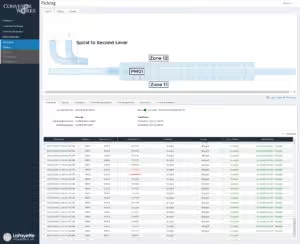
A WCS coordinates automated equipment and material movement.
Depending on the system, it may communicate with:
- Conveyors
- Sorters
- Scanners
- Automated storage equipment
- Robotics
- Equipment controls
The WMS generally manages warehouse activities and inventory, while the WCS helps coordinate the physical automation supporting those activities.
Not every mid-size warehouse needs a dedicated WCS.
The need depends on the complexity of the equipment and software architecture.
Picking Automation
Order picking is often one of the most labor-intensive warehouse activities.
Employees may spend substantial time walking between storage locations, identifying products, and transporting completed picks.
Automation can help improve this process.
Common approaches include:
- Pick-to-light systems
- Voice-directed picking
- Goods-to-person systems
- Automated storage
- Robotic assistance
- Conveyor-supported picking
A pick-to-light system, for example, can direct employees toward the correct product location and indicate the quantity required.
This may improve consistency without requiring a fully robotic operation.
The appropriate solution depends on order profiles, SKU characteristics, and throughput.
Packaging and Sortation Automation
Packing and shipping operations can also benefit from automation.
Potential technologies include:
- Automatic carton sealing
- Label application
- Dimensioning equipment
- Weighing systems
- Barcode verification
- Automated sortation
These systems can help reduce repetitive tasks and improve consistency.
For example, automated sortation can direct completed packages toward shipping lanes based on destination or carrier information.
However, equipment capacity must align with the rest of the facility.
Installing a high-speed sorter provides limited value if upstream picking cannot supply enough products or downstream shipping cannot handle the output.
The Importance of Facility Layout
Warehouse automation doesn’t operate independently from the building.
Equipment placement affects:
- Material travel distances
- Employee movement
- Forklift traffic
- Maintenance access
- Emergency routes
- Storage capacity
A poorly designed layout can reduce the value of otherwise excellent technology.
LaFayette Engineering understands that material flow and facility design must be considered together.
Before installing automation, businesses should evaluate whether changes to the existing layout could improve efficiency.
Sometimes moving workstations or reorganizing storage provides meaningful benefits without major equipment purchases.
How Much Does Warehouse Automation Cost?
Automation costs vary significantly.
A basic conveyor installation may require a very different investment from an automated storage system or large robotic fleet.
Costs can include:
- Equipment
- Engineering
- Installation
- Electrical infrastructure
- Software
- Integration
- Training
- Maintenance
Businesses should also consider indirect costs, including operational disruption during installation.
The most useful question is not simply how much automation costs.
It is whether the expected operational benefits justify the total investment.
A responsible financial evaluation should consider labor requirements, throughput, maintenance, equipment lifespan, and realistic performance expectations.
Measuring Return on Investment
Automation should create measurable value.
Potential performance indicators include:
- Orders processed per hour
- Labor hours per order
- Picking accuracy
- Equipment utilization
- Inventory accuracy
- Downtime
- Cost per shipment
Before investing, businesses should establish baseline measurements.
Without understanding current performance, it becomes difficult to determine whether automation actually improved the operation.
LaFayette Engineering can help organizations approach system improvements with clear operational goals.
Common Warehouse Automation Mistakes
Several mistakes can reduce the value of an automation project.
Automating an Inefficient Process
Technology may simply make a poorly designed process operate faster without solving its underlying problems.
Ignoring Product Characteristics
Equipment must be compatible with product dimensions, weights, packaging, and handling requirements.
Underestimating Integration
Software and machinery must communicate correctly.
Forgetting Maintenance
Automated equipment requires inspections, repairs, and technical support.
Overlooking Employees
Workers need training and clear procedures for interacting with new systems.
Failing to Plan for Growth
A system designed only for current demand may become constrained as order volume increases.
Avoiding these mistakes begins with careful planning.
Why Phased Automation Often Makes Sense
For many mid-size facilities, implementing automation in stages can be more practical than attempting a complete transformation at once.
A phased strategy might begin with:
- Improving warehouse layout and inventory organization.
- Introducing scanning or software improvements.
- Adding conveyors to reduce manual transportation.
- Automating selected picking or sorting processes.
- Expanding automation as operational needs grow.
This approach allows businesses to evaluate results before committing to additional investments.
It can also reduce disruption and provide employees with time to adapt.
Safety and Employee Training
Automated equipment can improve operations, but it also introduces new safety considerations.
Facilities may need to address:
- Machine guarding
- Emergency stops
- Lockout/tagout
- Pedestrian routes
- Robot traffic
- Maintenance access
- Employee training
Safety should be considered during initial design rather than after installation.
Employees should understand how to operate around automated equipment and what procedures apply when problems occur.
A successful automation project improves both operational performance and the working environment.
How LaFayette Engineering Can Help
Warehouse automation is most successful when equipment, software, employees, and facility design work together.
LaFayette Engineering brings an industrial engineering perspective to material-handling challenges.
Its approach can help businesses evaluate:
- Facility layouts
- Material flow
- Conveyor requirements
- Storage systems
- Automation opportunities
- Equipment integration
- Operational bottlenecks
- Future expansion
Rather than recommending technology simply because it is available, the goal is to identify solutions that fit the client’s actual operation.
For mid-size warehouses, this practical approach can be especially valuable.
Frequently Asked Questions
1. What is warehouse automation?
Warehouse automation uses equipment, software, and controls to perform or assist with material handling, inventory management, picking, sorting, packing, and shipping tasks.
2. Does every warehouse need automation?
No. The need depends on order volume, labor requirements, product characteristics, facility layout, and operational challenges.
3. Is warehouse automation only for large companies?
No. Mid-size businesses can benefit from appropriately scaled technologies such as conveyors, scanning systems, pick-to-light equipment, and warehouse software.
4. Can automation reduce labor requirements?
Automation can reduce repetitive manual tasks and change how labor is allocated. Actual staffing effects depend on the system and operation.
5. What is the best first step toward automation?
Begin by analyzing current workflows, bottlenecks, labor requirements, and throughput before selecting equipment.
6. How can LaFayette Engineering help?
LaFayette Engineering can help businesses evaluate material flow, facility layouts, equipment requirements, automation integration, and long-term operational goals.
Conclusion: Practical Automation Beats Expensive Hype

Warehouse automation doesn’t have to mean replacing every employee with robots or rebuilding an entire distribution center.
For mid-size operations, the most effective improvements are often targeted solutions that address specific problems.
A conveyor may reduce unnecessary transportation. Better inventory software may improve accuracy. Pick-to-light technology may simplify order fulfillment. Automated storage may help facilities use limited space more efficiently.
The key is understanding what the operation actually needs.
LaFayette Engineering can help businesses approach warehouse automation through practical engineering, careful planning, and a focus on measurable operational improvements.
In 2026, the smartest warehouse isn’t necessarily the one with the most technology.
It’s the one where people, equipment, software, and processes work together efficiently—and where every automation investment serves a clear purpose.
Interested in learning more about warehouse automation? Click here to contact LaFayette Engineering.