Table of Contents
Introduction: Choosing the Right Warehouse Technology Matters
Warehouse automation continues to transform the way businesses manage inventory, process orders, coordinate equipment, and move products through their facilities. As distribution centers and manufacturing operations become more sophisticated, companies increasingly rely on software to keep their material-handling systems operating efficiently.
However, choosing the right technology isn’t always straightforward.
Two commonly discussed solutions are warehouse control systems (WCS) and warehouse execution systems (WES). Although these technologies share some capabilities, they serve different purposes within automated warehouse environments.
Understanding WCS vs WES is essential for businesses looking to improve productivity, reduce operational bottlenecks, and make smarter investments in automation.
A warehouse control system primarily coordinates automated material-handling equipment, while a warehouse execution system helps manage and optimize the execution of warehouse tasks across equipment, labor, and operational processes.
For some facilities, a WCS provides everything necessary to keep automated systems working together. Others benefit from the broader coordination and decision-making capabilities of a WES.
LaFayette Engineering understands that successful warehouse automation requires more than purchasing software. Equipment, controls, workflows, employees, and facility layouts must work together to support the organization’s operational goals.
Before investing in either platform, businesses should understand what each system does and how it fits into their operation.
What Is a Warehouse Control System?
A warehouse control system is software designed to coordinate automated material-handling equipment within a warehouse or distribution center.
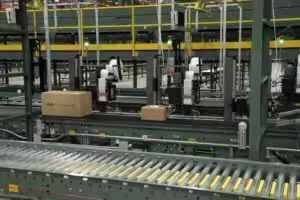
A WCS commonly communicates with conveyors, sorters, scanners, automated storage equipment, and other technologies to help direct the physical movement of products.
Typical WCS functions may include:
- Conveyor routing
- Automated sortation
- Accumulation management
- Equipment status monitoring
- Barcode scanning coordination
- Material movement
- Communication with equipment controllers
- Exception handling
For example, imagine a carton traveling through an automated distribution center.
The warehouse management system identifies the carton and determines its intended destination. The WCS then coordinates the equipment responsible for transporting it through the conveyor network.
Individual programmable logic controllers, or PLCs, execute machine-level actions such as operating motors, sensors, and diverters.
In the WCS vs WES comparison, the WCS is generally more focused on the physical automation layer.
Its primary objective is to help automated equipment operate as a coordinated system.
What Is a Warehouse Execution System?
A warehouse execution system is software designed to coordinate and optimize the execution of warehouse activities.
A WES may combine functions traditionally associated with warehouse management and warehouse control.
Depending on the platform, its capabilities can include:
- Task prioritization
- Order release
- Workload balancing
- Labor coordination
- Automation orchestration
- Real-time operational decisions
- Equipment utilization monitoring
- Workflow optimization
For example, a WES may evaluate current order demand, available labor, equipment capacity, and shipping deadlines before determining which work should be released next.
Rather than simply directing products through automated equipment, it can help coordinate the timing and priority of work throughout the facility.
This broader operational focus is one of the most important distinctions when evaluating WCS vs WES.
However, software capabilities vary significantly between vendors. Some WCS platforms offer advanced execution features, while certain WES products include direct equipment-control capabilities.
Businesses should evaluate actual functionality rather than relying exclusively on software labels.
WCS vs WES: Understanding the Main Difference
The simplest way to understand WCS vs WES is to compare equipment coordination with operational execution.
A WCS primarily helps automated equipment perform assigned tasks.
A WES helps determine how warehouse work should be organized and executed across available resources.
Consider a distribution center processing thousands of orders.
The WCS may coordinate conveyors and sorters to move cartons toward their destinations.
The WES may evaluate which orders should be released first, how workloads should be distributed, and whether equipment or labor capacity can support additional work.
Both systems can contribute to operational efficiency, but they approach the challenge from different perspectives.
A WCS focuses on material movement.
A WES focuses on coordinating work execution.
WCS vs WES: Key Features Compared
| Feature | Warehouse Control System (WCS) | Warehouse Execution System (WES) |
|---|---|---|
| Primary purpose | Coordinate automated equipment | Coordinate warehouse work execution |
| Conveyor routing | Common capability | May include or integrate |
| Automated sortation | Common capability | May include or integrate |
| Equipment monitoring | Common capability | Often included |
| Order release | Usually directed by higher-level software | Common capability |
| Task prioritization | Limited or integration-based | Common capability |
| Labor coordination | Usually limited | May be included |
| Workload balancing | Equipment-focused | Facility-wide |
| Real-time optimization | Material-flow focused | Operational workflow focused |
| Integration with WMS | Common | Common |
| Best fit | Equipment-intensive automation | Complex operations requiring dynamic coordination |
Understanding these differences helps businesses determine which capabilities are most valuable.
The right choice depends on operational requirements rather than which platform offers the longest feature list.
When Does Your Operation Need a WCS?
A warehouse control system may be appropriate when the primary challenge involves coordinating automated equipment.
For example, a facility may contain:
- Multiple conveyor lines
- Automated sorters
- Accumulation zones
- Barcode scanners
- Automated storage systems
- Equipment from several manufacturers
These technologies need to exchange information and respond to changing operating conditions.
A WCS can help coordinate this activity.
Suppose a downstream conveyor becomes temporarily unavailable.
The WCS may coordinate upstream accumulation or approved alternative routing to prevent products from overwhelming the affected area.
This type of equipment-focused coordination is where a WCS can provide substantial value.
When evaluating WCS vs WES, facilities with complex automation but relatively straightforward order-release processes may find that a WCS meets their needs.
When Does Your Operation Need a WES?
A warehouse execution system becomes more attractive when the facility needs to coordinate work dynamically across multiple processes.
For example, a distribution center may struggle with:
- Uneven workloads
- Order-release timing
- Labor allocation
- Equipment congestion
- Changing shipping priorities
- Multiple fulfillment processes
A WES can help evaluate these conditions and coordinate work accordingly.
Imagine that a facility has several picking zones feeding a shared packing area.
If orders are released without considering downstream capacity, packing may become overwhelmed while other resources remain underutilized.
A WES may help regulate order release and balance workloads according to available capacity.
In the WCS vs WES decision, this ability to coordinate operational priorities is one of the strongest reasons to consider a WES.
Does Every Warehouse Need Both Systems?
Not necessarily.
Some facilities operate effectively using a warehouse management system and basic equipment controls.
Others need a dedicated WCS because automated material-handling equipment requires centralized coordination.
More complex operations may benefit from a WES that provides broader execution management.
Some software platforms combine WCS and WES capabilities into one solution.
The appropriate architecture depends on:
- Order volume
- Automation complexity
- Equipment integration
- Labor requirements
- Throughput
- Operational variability
- Future expansion
The WCS vs WES decision should begin with understanding the facility’s actual needs.
Installing unnecessary software can increase costs and complexity without delivering meaningful improvements.
How WCS and WES Work With a Warehouse Management System
A warehouse management system, or WMS, generally manages inventory and warehouse business processes.
Common functions include:
- Receiving
- Inventory tracking
- Storage location management
- Picking instructions
- Order management
- Shipping coordination
A WCS coordinates automated equipment.
A WES coordinates warehouse work execution.
In a facility using all three systems, a simplified process might look like this:
- The WMS identifies orders requiring fulfillment.
- The WES evaluates operational priorities and available capacity.
- The WES coordinates work release.
- The WCS directs automated material movement.
- Equipment controllers execute machine-level actions.
- Status information returns to the appropriate systems.
This architecture can create a coordinated relationship between inventory information, operational decisions, and physical equipment.
However, actual system responsibilities depend on the software products and integration design.
Why Real-Time Decision-Making Matters
Warehouse operations change constantly.
New orders arrive, equipment becomes unavailable, shipping priorities change, and employees move between tasks.
A static workflow may struggle to respond efficiently.
Modern warehouse execution technology can help facilities make decisions based on current operating conditions.
For example, a WES may adjust order-release priorities when a shipping deadline approaches or when a processing area becomes congested.
A WCS may respond to equipment availability by coordinating routing and accumulation.
Understanding WCS vs WES helps businesses recognize that real-time decisions can occur at different levels.
Equipment-level decisions and facility-wide operational decisions are related, but they are not identical.
The Role of Conveyor Systems
Conveyors are among the most common technologies involved in warehouse automation.
They transport cartons, totes, packages, and materials between work areas.
Common types include:
- Belt conveyors
- Powered roller conveyors
- Gravity conveyors
- Accumulation conveyors
- Sortation conveyors
A WCS can coordinate how products move through these systems.
A WES may help determine when work should enter the conveyor network based on downstream capacity and operational priorities.
This distinction is especially important in facilities with high throughput.
LaFayette Engineering understands that conveyor performance depends on both physical design and software coordination.
A well-designed conveyor network needs appropriate capacity, equipment placement, maintenance access, and controls integration.
WCS vs WES and Warehouse Bottlenecks
Bottlenecks can reduce productivity even when individual pieces of equipment operate correctly.
A facility may experience congestion because:
- Orders are released too quickly
- Packing capacity is limited
- Sortation destinations become full
- Picking zones operate at different speeds
- Equipment experiences temporary interruptions
A WCS may help manage equipment-level congestion through routing and accumulation.
A WES may help prevent broader congestion by coordinating work release and balancing operational demand.
When comparing WCS vs WES, businesses should identify whether their primary bottlenecks involve physical equipment coordination or broader workflow management.
This distinction can help determine which technology provides the greatest value.
Why Facility Layout Still Matters
Software cannot completely compensate for a poorly designed warehouse.
A facility may have sophisticated automation but still experience excessive travel, congestion, or inefficient material flow.
Important layout considerations include:
- Conveyor placement
- Storage locations
- Picking areas
- Packing stations
- Shipping lanes
- Employee traffic
- Maintenance access
LaFayette Engineering approaches warehouse improvement from a complete-system perspective.
Before recommending additional automation, businesses should evaluate whether physical layout changes could improve operations.
Sometimes moving equipment or reorganizing workflows can provide meaningful benefits without major software investments.
Integration Challenges Businesses Should Consider
Implementing a WCS or WES requires careful integration planning.
Potential challenges include:
- Connecting equipment from different manufacturers
- Integrating existing warehouse software
- Defining system responsibilities
- Managing communication failures
- Coordinating operational data
- Handling exceptions
- Training employees
For example, project teams must determine what happens when a barcode cannot be read or a conveyor destination becomes unavailable.
These situations should be addressed during system design.
The WCS vs WES comparison should therefore include integration requirements, not simply software features.
Evaluating the Cost of WCS vs WES
Software costs vary depending on functionality, system complexity, integration requirements, and vendor pricing.
Potential expenses include:
- Software licensing
- Implementation
- Equipment integration
- Infrastructure upgrades
- Employee training
- Maintenance
- Technical support
A WES may involve broader operational integration, while a WCS may require extensive equipment-level interfaces.
Neither option is automatically less expensive.
Businesses should evaluate total ownership costs alongside expected operational benefits.
The goal is to select a system that addresses real problems and provides measurable value.
Measuring Return on Investment
Automation investments should be evaluated using clear performance indicators.
Potential metrics include:
- Orders processed per hour
- Equipment utilization
- Labor productivity
- Picking accuracy
- Conveyor downtime
- Order cycle time
- Cost per shipment
Before implementing new software, businesses should establish baseline performance.
This makes it easier to determine whether the investment produces meaningful improvements.
LaFayette Engineering can help organizations approach warehouse technology decisions with practical operational goals.
Common Mistakes When Choosing Between WCS and WES
Several mistakes can lead to disappointing results.
Choosing Software Before Identifying the Problem
Businesses should understand their operational challenges before selecting technology.
Assuming All Platforms Are Identical
Vendor capabilities vary significantly.
Ignoring Existing Equipment
Software must work with the facility’s actual automation infrastructure.
Underestimating Integration
Connecting multiple systems requires careful planning and testing.
Forgetting Employee Training
Workers need to understand how new technology affects daily operations.
Failing to Plan for Growth
Future automation requirements should be considered during initial system selection.
Avoiding these mistakes begins with a realistic understanding of WCS vs WES and the facility’s operational needs.
How LaFayette Engineering Can Help
Warehouse software decisions should be connected to the physical systems they support.
LaFayette Engineering brings industrial engineering and material-handling knowledge to projects involving:
- Conveyor systems
- Facility layouts
- Material flow
- Automation integration
- Equipment coordination
- Operational efficiency
- Future expansion
The company’s practical engineering approach helps businesses evaluate how technology fits into their existing operations.
For organizations considering WCS vs WES, understanding conveyor capacity, equipment integration, workflows, and facility constraints is an important part of making the right decision.
Rather than selecting technology based on trends, businesses should focus on solutions that address measurable operational challenges.
Frequently Asked Questions
1. What is the difference between WCS and WES?
A warehouse control system primarily coordinates automated material-handling equipment, while a warehouse execution system manages and optimizes warehouse work execution across equipment, labor, and operational processes.
2. Which is better, WCS or WES?
Neither is universally better. The right choice depends on automation complexity, operational requirements, workflow challenges, and existing software.
3. Can a warehouse use both systems?
Yes. Some facilities use a WES for operational coordination and a WCS for equipment-level automation.
4. Does a WES replace a WMS?
Not necessarily. A WES often works alongside a WMS, which continues managing inventory and warehouse business processes.
5. Is WCS vs WES important for smaller warehouses?
It can be, particularly when smaller or mid-size facilities begin adding automation. However, some operations may not need either dedicated platform.
6. How can LaFayette Engineering help with WCS vs WES decisions?
LaFayette Engineering can help businesses evaluate material flow, conveyor systems, facility layouts, automation requirements, and equipment integration to support informed warehouse technology decisions.
Conclusion: Choose the Technology Your Operation Actually Needs

Understanding WCS vs WES is essential for businesses considering warehouse automation.
A warehouse control system focuses primarily on coordinating automated material-handling equipment. A warehouse execution system provides broader capabilities for coordinating warehouse work, managing priorities, and balancing operational resources.
Both technologies can improve warehouse performance when applied appropriately.
However, the best solution depends on the facility’s actual requirements.
Businesses should evaluate their equipment, workflows, throughput, labor needs, existing software, and future growth before making an investment.
LaFayette Engineering understands that successful warehouse automation involves more than purchasing sophisticated technology.
Conveyors, controls, software, employees, and facility layouts must work together to support efficient operations.
For organizations comparing WCS vs WES, the smartest approach is to begin with practical engineering, clearly defined operational goals, and a realistic understanding of what each system can accomplish.
The right technology isn’t necessarily the most advanced or expensive option. It’s the one that helps your warehouse operate more efficiently today while preparing for tomorrow’s demands.
Interested in learning more about Warehouse technologies? Contact LaFayette Engineering here to explore further.