
An arc flash label is a warning label on electrical equipment, such as a conveyor control panel, motor control center, or disconnect, that tells workers an arc flash hazard exists and, in its detailed form, how severe it is and what protection is required. It’s the first thing a qualified electrician should read before opening an energized panel.
For operations and maintenance leaders, the label is also a record. It shows whether the facility has assessed the hazard on that piece of equipment, and whether the assessment still matches the building. This guide explains how to read an arc flash label, what OSHA and the consensus standards expect, who is responsible for each part, and why the label on a new conveyor control panel depends on the building it’s installed in.
At a glance
- There are two kinds of label: a general warning required by the National Electrical Code, and a detailed label from the facility’s arc flash risk assessment under NFPA 70E.
- A detailed arc flash label shows the nominal voltage, the arc flash boundary, and either the incident energy at a working distance or a PPE category.
- OSHA doesn’t use the term “arc flash label,” but its electrical rules require hazard assessment, protective equipment, and warning signs, and NFPA 70E is the consensus standard most employers use to meet them.
- The employer, usually the facility owner, is responsible for the assessment and the detailed labels.
- A control panel can’t leave the panel shop with its final incident energy value, because that value depends on the building’s electrical system.
- Labels go out of date when the electrical system changes. Conveyor expansions are a common cause.
Table of Contents
Why the Arc Flash Label Matters to Operations
The problem: conveyor systems put dozens of control panels, VFD panels, remote I/O enclosures, and disconnects across a distribution center. Maintenance and contractors open them to troubleshoot, sometimes while energized, often under pressure because the line is down.
The consequence: an arc flash is an electrical explosion. It can cause severe burns, blast injuries, and hearing and eye damage, and it can destroy the equipment involved. When a panel has no arc flash label, or the label is wrong, the person opening it is guessing at the hazard. Outside contractors often stop work until it’s resolved, and an incident brings an investigation that looks first at what the employer knew and documented.
The engineering answer: treat the arc flash label as the visible end of a process: a current assessment of the electrical system, PPE selected from it, trained and qualified people, and equipment designed to reduce the need for energized work. A label that’s accurate and current tells you that process is working.
What OSHA Requires
The problem: leaders search for “arc flash label requirements” expecting a single OSHA rule. There isn’t one by that name.
The engineering answer: OSHA’s general industry electrical rules are performance-based. Several sections together create the obligation:
- Hazard assessment. 29 CFR 1910.132(d) requires the employer to assess the workplace for hazards that require personal protective equipment, select the PPE, communicate the selection to affected employees, and certify the assessment in writing.
- De-energize first. 29 CFR 1910.333(a)(1) requires live parts to be de-energized before employees work on or near them, unless the employer can show that de-energizing creates greater hazards or is infeasible.
- Protection from arcs. 29 CFR 1910.335 requires appropriate electrical protective equipment, and eye or face protection wherever there is danger from electric arcs or flashes. It also requires safety signs, symbols, or tags where necessary to warn employees about electrical hazards.
- Qualified persons. OSHA defines a qualified person in 29 CFR 1910.399 as someone trained in, and able to demonstrate, the skills and knowledge for the construction and operation of electric equipment and the hazards involved.
The detail of how to assess arc flash hazards, mark equipment, and select PPE comes from the consensus standards below.
The Two Kinds of Arc Flash Label
The NEC general warning
The National Electrical Code (NFPA 70) requires a field or factory marking that warns of potential arc flash hazards on equipment likely to be examined, adjusted, serviced, or maintained while energized. Industrial control panels and motor control centers are among the equipment it lists. This arc flash label is a general warning. It says the hazard exists. It doesn’t say how large it is.
The NFPA 70E detailed label
NFPA 70E, the Standard for Electrical Safety in the Workplace, covers the employer’s arc flash risk assessment and the equipment labeling that comes from it. A detailed arc flash label reports the results of that assessment for a specific piece of equipment. Both NFPA 70 and NFPA 70E are licensed standards; this article describes them only at a high level, and your facility should work from the current editions.

How to Read an Arc Flash Label in 6 Parts
Layouts vary by the software and engineer that produced the label, but a detailed arc flash label carries the same core information.
1. The signal word
The header reads DANGER or WARNING, in the ANSI Z535 safety sign format. Facilities set their own rule for which header applies, often based on the incident energy or voltage. Either way, it means the same thing to the reader: stop and check the rest of the label before opening the equipment.
2. The equipment and the date
The label names the equipment it applies to and usually the date of the assessment or the study it came from. A date years old on a panel in a building that has grown since is a reason to ask questions.
3. Nominal voltage
The system voltage inside the equipment. It drives the shock protection requirements, and it tells the worker which voltage-rated tools and gloves are required.
4. Arc flash boundary
The distance from the equipment at which a person without arc-rated protection could receive a second-degree burn if an arc flash occurred. Anyone inside that boundary needs arc flash PPE. On a busy conveyor mezzanine, the boundary tells the supervisor how much area to control while a panel is open.
5. Incident energy or PPE category
This is the severity. A label shows one of two things:
- Incident energy at a working distance, in calories per square centimeter, calculated in an engineering study (commonly with the IEEE 1584 method). The PPE’s arc rating must meet or exceed it.
- An arc flash PPE category, from the tables in NFPA 70E, when the facility uses the table method for that equipment.
The standard has the employer use one method or the other for a given piece of equipment, so a label shouldn’t present both as competing answers.
6. Shock approach boundaries
Many labels also show the limited and restricted approach boundaries for shock. These tell unqualified people how close they can come and tell qualified workers where shock protection begins.
If any of these parts are missing, unreadable, or contradict each other, treat the arc flash label as unreliable and escalate it before anyone works in the panel energized.
Who Is Responsible for the Arc Flash Label
The problem: a new conveyor line involves a panel builder, an installing contractor, an electrical engineer, and the facility. Each assumes someone else handles the labels.
The engineering answer: the responsibilities split along the lines of who knows what.
| Party | Typical responsibility |
|---|---|
| Employer / facility owner | The arc flash risk assessment, the detailed labels, PPE, training, and the electrical safety program. Required to protect its own employees under OSHA. |
| Engineer performing the study | Modeling the electrical system, calculating incident energy and boundaries, and producing the label data. |
| Panel builder | Building and documenting the panel to the applicable codes and the customer’s specification, including the general warning marking where the panel builder applies it. |
| Installing contractor | Installing to code, applying field markings, and providing accurate as-built information for the study. |
| Contractors’ employers | Protecting their own workers, and exchanging hazard information with the host employer before work starts. |
The detailed arc flash label belongs to the employer because the employer owns the electrical system, and the hazard depends on that system. Who physically sticks the label on matters less than who owns the assessment behind it.
Why a New Control Panel Can’t Ship With Its Final Label
The problem: buyers sometimes ask the panel builder for a finished arc flash label with the panel.
The consequence: a label printed in the panel shop would show numbers nobody calculated for the actual installation. A wrong arc flash label is worse than a missing one, because people trust it.
The engineering answer: incident energy depends on two things outside the panel: how much fault current the building’s electrical system can deliver to that point, and how quickly the upstream protective device clears a fault. Both depend on the utility service, the transformers, the feeder lengths, and the breaker or fuse settings upstream. The panel shop doesn’t know those values. The study engineer calculates them once the panel’s place in the building’s one-line diagram is known.
The same physics drives a panel’s short circuit current rating (SCCR), which has to be at least the available fault current where the panel is installed. Good panel documentation helps here: accurate one-line information, component ratings, and the main disconnect and overcurrent devices give the study engineer what they need.
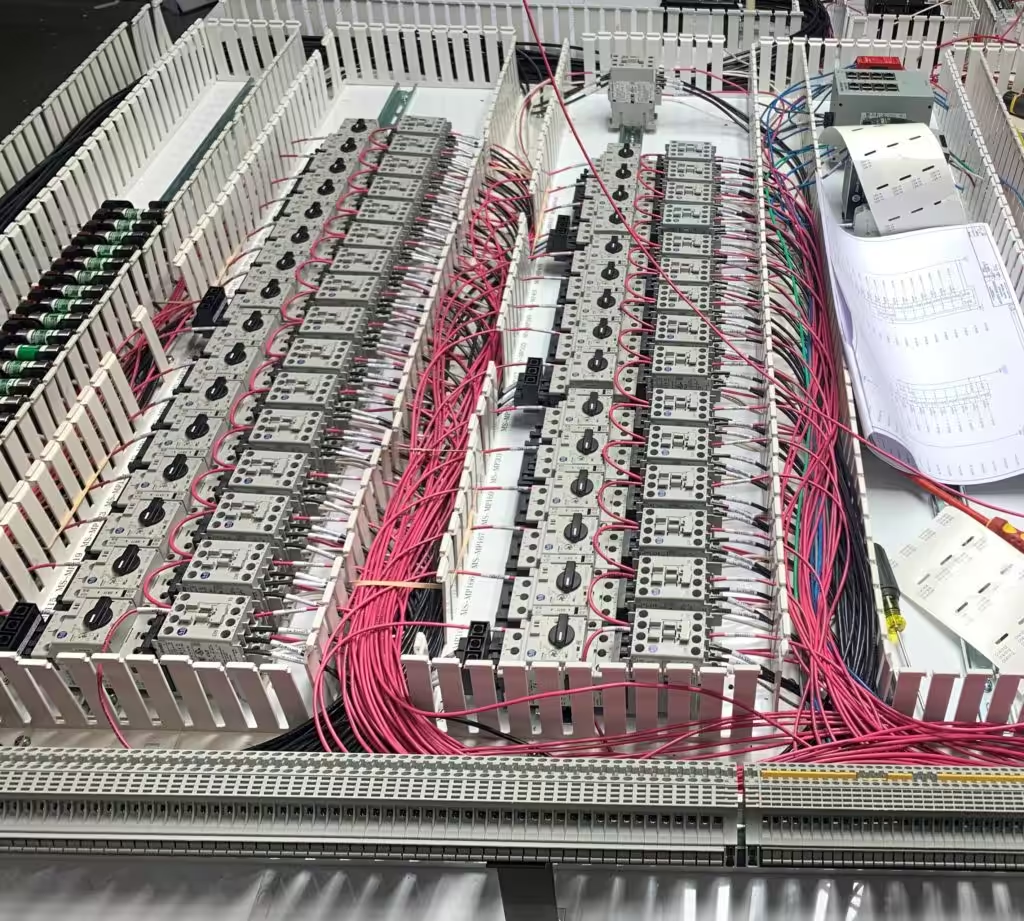
LaFayette Engineering builds its control panels in-house and tests each one before shipping. Its panel team makes sure products are properly labeled and documented to explain the system’s architecture and function.
When Arc Flash Labels Go Out of Date
The problem: labels are accurate on the day of the study. Buildings keep changing after that.
The consequence: a change upstream can raise the available fault current or slow a protective device, and the incident energy at a conveyor panel can rise even though nobody touched that panel. The arc flash label still shows the old value.
The engineering answer: update the assessment when the electrical system changes, and review it on a schedule. NFPA 70E calls for the arc flash risk assessment to be updated when a major modification or renovation takes place and reviewed periodically, at intervals not to exceed five years. Changes that commonly trigger a review in a distribution center include:
- A new or upgraded utility service or transformer
- New motor control panels or VFD panels for a conveyor expansion
- Changes to breaker trip settings or fuse types
- Added generation, solar, or backup power
- Relocated equipment or new feeders
For conveyor projects, build the study update into the project schedule. If a new sortation line adds panels in March, the labels on those panels and on the upstream distribution equipment should be current before the line goes live.
Design Choices That Reduce Arc Flash Exposure
The problem: the safest arc flash is the one nobody is standing in front of. OSHA’s starting point is de-energized work, yet conveyor troubleshooting often pulls technicians into energized panels.
The engineering answer: controls design can reduce how often anyone needs to open an energized panel.
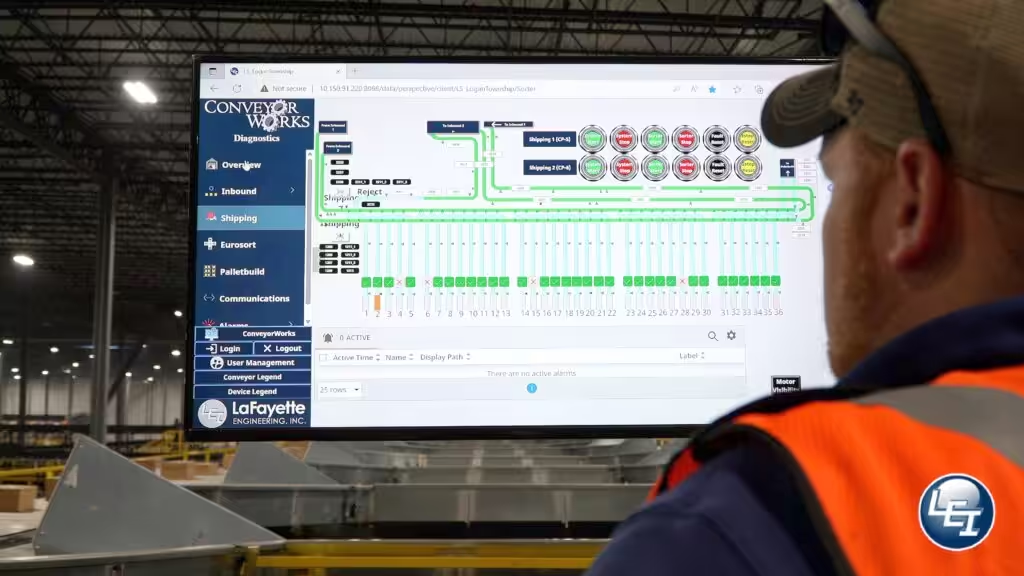
- Diagnostics at the HMI. When faults, I/O status, and drive status are visible on a screen, technicians find the problem before opening a door.
- Through-door programming and network ports. A technician can connect a laptop to the PLC without opening the enclosure.
- Remote support. LEI’s support team can connect directly to the PLC over a customer’s VPN, so many issues are diagnosed without anyone at the panel.
- Clear isolation points. Labeled disconnects for each section make it practical to de-energize the part being worked on without stopping the whole system.
- Low-voltage control circuits. Separating 24 VDC control wiring from higher-voltage power reduces exposure during control troubleshooting.
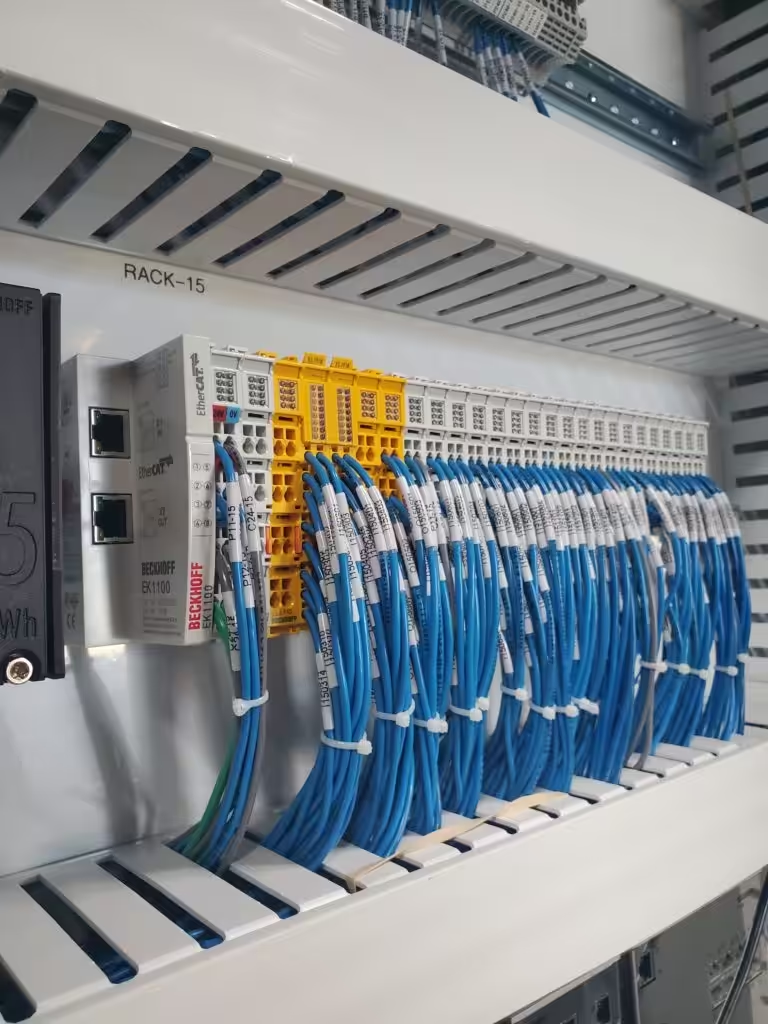
- Documentation at the panel. Current drawings, labeled wiring, and a clear arc flash label let the next person work safely and quickly.
LEI’s guide to NFPA 79 for conveyor controls covers how the electrical standard for industrial machinery shapes panel and field wiring decisions.
A Leadership Checklist
Use these questions to check where your facility stands:
- Does every conveyor control panel, MCC, VFD panel, and disconnect that may be serviced energized carry an arc flash label?
- When was the arc flash risk assessment last updated, and has the electrical system changed since?
- Were the last conveyor additions included in the study?
- Do labels use one method consistently (incident energy or PPE category) for each piece of equipment?
- Does the PPE in the maintenance shop match what the labels require?
- Who decides when energized work is justified, and is that decision documented?
- Do contractors receive the hazard information before they start?
- Can common faults be diagnosed from the HMI or remotely, without opening a panel?
How LaFayette Engineering Fits
LaFayette Engineering designs and installs controls for conveyor systems, including high-speed case sortation. That work includes control panel design and fabrication in-house, from small push-button enclosures to large motor control panels, and electrical installation by qualified technicians and electricians working to applicable codes and standards.
For arc flash labeling, LEI’s role is to deliver panels and installations that are well documented and designed for safe maintenance, and to give your study engineer accurate information about what was installed. This article is general information, not engineering, legal, or safety advice. Your facility’s electrical safety program, a qualified engineer’s study, and the current editions of the cited codes and standards govern your site.
Frequently Asked Questions
What is an arc flash label?
An arc flash label is a warning label on electrical equipment that alerts workers to an arc flash hazard. A detailed label also shows the nominal voltage, the arc flash boundary, and the incident energy or PPE category, based on the facility’s arc flash risk assessment.
Does OSHA require arc flash labels?
OSHA doesn’t use the term “arc flash label,” but its rules require employers to assess hazards, provide protective equipment for arc hazards, and use warning signs where electrical hazards exist. NFPA 70E is the consensus standard most employers use to meet those requirements, and it covers equipment labeling.
What information is on an arc flash label?
A detailed arc flash label typically shows a signal word, the equipment name, the date, the nominal voltage, the arc flash boundary, and either the incident energy at a working distance or an arc flash PPE category. Many labels also show shock approach boundaries.
Who is responsible for arc flash labels?
The employer, usually the facility owner, is responsible for the arc flash risk assessment and the detailed labels. Engineers perform the study, panel builders and installers provide accurate documentation, and installers may apply the code-required general warning marking.
Can a panel builder put the final arc flash label on a new control panel?
Not with accurate incident energy values. Those values depend on the building’s available fault current and the clearing time of upstream protective devices, which are calculated in the facility’s study after the panel’s place in the electrical system is known.
How often should arc flash labels be updated?
NFPA 70E calls for the arc flash risk assessment to be updated after major modifications and reviewed at intervals not to exceed five years. Labels should be updated whenever the assessment changes, including after conveyor expansions.
What is the arc flash boundary?
The arc flash boundary is the distance from the equipment at which a person without arc-rated protection could receive a second-degree burn if an arc flash occurred. Anyone inside it needs arc flash PPE.
Why might two similar conveyor panels have different arc flash labels?
Incident energy depends on where each panel sits in the building’s electrical system. Two identical panels fed from different transformers or breakers can see different fault currents and clearing times, and so carry different values on their arc flash label.