Table of Contents
Introduction: Understanding Warehouse Control System vs Warehouse Management System
Modern warehouses rely on sophisticated technology to manage inventory, process orders, coordinate equipment, and move products efficiently. As distribution centers and manufacturing facilities become increasingly automated, businesses need software capable of managing both warehouse operations and physical material-handling equipment.
Two of the most important technologies are warehouse management systems (WMS) and warehouse control systems (WCS).
Understanding the warehouse control system vs warehouse management system problem is essential for businesses seeking to improve inventory accuracy, order fulfillment, automation performance, and overall productivity.
Although these systems work closely together, they serve different purposes.
A warehouse management system focuses primarily on inventory, orders, and operational processes. A warehouse control system coordinates the automated equipment responsible for moving products through the facility.
LaFayette Engineering understands that successful warehouse automation requires both reliable software and properly engineered material-handling systems.
By understanding the differences in a warehouse control system vs warehouse management system, businesses can make better decisions about technology investments, equipment integration, and future facility improvements.
What Is a Warehouse Management System?
A warehouse management system is software designed to organize and manage daily warehouse operations.
Its primary purpose is to maintain accurate inventory information while coordinating activities such as receiving, storage, picking, packing, and shipping.
A WMS commonly manages:
- Inventory locations
- Receiving operations
- Order processing
- Picking instructions
- Replenishment
- Packing
- Shipping
- Inventory reporting
For example, imagine a distribution center receives an order containing several products.
The WMS identifies where those products are stored, determines which inventory should be selected, and creates the tasks required to fulfill the order.
This functionality is one of the most important distinctions when comparing warehouse control system vs warehouse management system.
The WMS manages the information and business processes that keep warehouse operations organized.
What Is a Warehouse Control System?
A warehouse control system is software designed to coordinate automated material-handling equipment.
Rather than focusing primarily on inventory records, a WCS helps control how products move through conveyors, sorters, scanners, and other automated technologies.
A WCS may coordinate:
- Conveyor systems
- Automated sortation
- Accumulation conveyors
- Barcode scanning
- Material routing
- Automated storage systems
- Robotic equipment
- Equipment status monitoring
Consider a carton traveling toward a shipping lane.
The WMS determines where the carton needs to go. The WCS coordinates the automated equipment that moves it toward that destination.
This difference forms the foundation of what makes a warehouse control system vs warehouse management system.
Both technologies contribute to successful operations, but they manage different responsibilities.
Warehouse Control System vs Warehouse Management System: The Main Difference
The simplest explanation is that a WMS manages warehouse activities while a WCS coordinates physical automation.
A warehouse management system answers questions such as:
- What inventory is available?
- Where is it stored?
- Which orders need fulfillment?
- What products should be picked?
- Which shipments are ready?
A warehouse control system addresses questions such as:
- Which conveyor route should a carton follow?
- Is a sorting destination available?
- Should products accumulate temporarily?
- Is automated equipment ready to receive another load?
- Where should a product move next?
Understanding warehouse control system vs warehouse management system functions helps businesses recognize why these systems often complement one another.
One manages operational information, while the other coordinates equipment execution.
Warehouse Control System vs Warehouse Management System: Key Features
| Feature | Warehouse Management System | Warehouse Control System |
|---|---|---|
| Primary responsibility | Inventory and operations | Automated material movement |
| Inventory tracking | Core function | Limited or integration-based |
| Order management | Core function | Supports execution |
| Conveyor coordination | Usually through integration | Common capability |
| Automated sorting | Usually through integration | Common capability |
| Equipment monitoring | Limited or integration-based | Common capability |
| Picking management | Core function | Supports automated movement |
| Shipping coordination | Core function | Supports routing to shipping |
| Main focus | Warehouse information | Physical automation |
When evaluating warehouse control system vs warehouse management system, businesses should remember that specific capabilities vary by software provider.
Some platforms combine functions traditionally associated with WMS, WCS, and warehouse execution systems.
Why Warehouse Management Systems Matter
Inventory accuracy is one of the foundations of successful warehouse operations.
Without reliable inventory records, businesses may experience:
- Incorrect orders
- Missing products
- Picking delays
- Replenishment problems
- Shipping errors
- Inventory discrepancies
A WMS helps maintain accurate information as products move through the facility.
This information supports better decisions and more consistent operations.
When comparing warehouse control system vs warehouse management system, the WMS is particularly valuable for businesses struggling with inventory visibility and order coordination.
Even warehouses with limited automation may benefit from an effective WMS.
Why Warehouse Control Systems Matter
Automated equipment requires coordination.
A modern distribution center may contain multiple conveyor lines, sorters, scanners, accumulation zones, and automated storage systems.
These technologies must communicate to prevent congestion and routing errors.
A WCS helps coordinate this activity.
For example, if a downstream sorting lane becomes temporarily unavailable, the system may direct products toward another approved destination or coordinate accumulation until capacity returns.
This capability becomes increasingly important as facilities add automation.
In the warehouse control system vs warehouse management system comparison, the WCS is especially valuable for managing complex physical material flow.
How Warehouse Control Systems and Warehouse Management Systems Work Together
Understanding warehouse control system vs warehouse management system becomes easier when following a product through the fulfillment process.
Step 1: An Order Enters the Warehouse
A customer places an order, and the relevant information is transmitted to the WMS.
Step 2: The WMS Creates Picking Tasks
The WMS identifies inventory locations and determines which products need to be selected.
Step 3: Products Enter the Conveyor Network
After picking, cartons or totes are placed onto automated material-handling equipment.
Step 4: The WCS Coordinates Product Movement
The WCS receives routing information and helps direct products through the appropriate conveyor paths.
Step 5: Equipment Controls Execute Actions
Programmable logic controllers operate motors, sensors, diverters, and other machine-level equipment.
Step 6: Products Reach Packing or Shipping
The automated system transports products toward their intended destinations.
Step 7: The WMS Updates Inventory Records
Relevant confirmations are communicated back to the WMS.
This example demonstrates why warehouse control system vs warehouse management system is not necessarily an either-or decision.
Both systems can contribute to a coordinated warehouse operation.
Warehouse Control System vs Warehouse Management System in Conveyor Automation
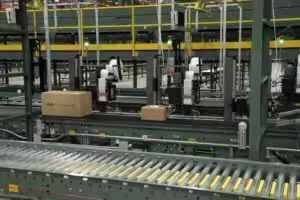
Conveyor systems are among the most common technologies used in automated warehouses.
They transport cartons, totes, packages, and other materials between workstations.
Common conveyor technologies include:
- Belt conveyors
- Powered roller conveyors
- Gravity conveyors
- Accumulation conveyors
- Sortation conveyors
A WCS can coordinate routing decisions and equipment availability throughout the conveyor network.
The WMS provides the inventory and order information needed to determine where products should go.
Understanding warehouse control system vs warehouse management system helps businesses recognize how software and conveyors work together.
LaFayette Engineering can help organizations evaluate conveyor layouts, material flow, and equipment integration as part of broader automation planning.
The Role of Programmable Logic Controllers
Programmable logic controllers, commonly called PLCs, operate equipment at the machine level.
They may control:
- Conveyor motors
- Sensors
- Diverters
- Accumulation zones
- Equipment sequences
A WCS coordinates higher-level equipment activity, while PLCs execute machine-level commands.
This distinction is important because warehouse automation involves several layers of technology.
When researching warehouse control system vs warehouse management system, businesses should also understand how equipment controls fit into the overall architecture.
A successful system clearly defines the responsibilities of each software and control layer.
Warehouse Control System vs Warehouse Management System vs Warehouse Execution System
Another technology frequently discussed in warehouse automation is the warehouse execution system, or WES.
A WES may combine functions associated with warehouse management and warehouse control.
Depending on the platform, it can support:
- Task prioritization
- Workload balancing
- Automation coordination
- Order release
- Real-time operational decisions
This creates additional considerations when evaluating warehouse control system vs warehouse management system.
Some facilities use separate WMS, WCS, and WES platforms.
Others use integrated software that combines several functions.
The correct architecture depends on operational complexity, automation requirements, and business goals.
Does Every Warehouse Need Both Systems?
Not every warehouse requires separate WMS and WCS software.
A smaller operation with limited automation may function effectively using a WMS and basic equipment controls.
A highly automated distribution center may benefit from dedicated warehouse control software.
Businesses should evaluate:
- Order volume
- Inventory complexity
- Conveyor equipment
- Automated sorting
- Robotic systems
- Software integration
- Future expansion
The warehouse control system vs warehouse management system decision should be based on actual operational requirements.
Installing unnecessary technology can increase costs without producing meaningful benefits.
When Should a Business Invest in a WMS?
A warehouse management system may be the appropriate first investment when a facility experiences:
- Poor inventory accuracy
- Frequent picking errors
- Difficulty locating products
- Inefficient receiving
- Replenishment problems
- Limited order visibility
These issues primarily involve warehouse information and operational processes.
Understanding warehouse control system vs warehouse management system helps businesses avoid investing in equipment-control software when their most significant problems involve inventory management.
A WMS can create value even without extensive automation.
When Should a Business Invest in a WCS?
A warehouse control system becomes increasingly valuable as automated material-handling systems grow more complex.
Potential indicators include:
- Multiple conveyor lines
- Automated sortation equipment
- Complex routing requirements
- High throughput
- Frequent accumulation
- Multiple equipment manufacturers
- Automated storage integration
A WCS helps coordinate equipment and material movement across the facility.
When evaluating warehouse control system vs warehouse management system, businesses with extensive automation should pay particular attention to WCS capabilities.
Why Software Integration Matters
Software integration is one of the most important considerations in warehouse automation.
The WMS and WCS must exchange accurate information at appropriate times.
Potential integration challenges include:
- Incompatible interfaces
- Delayed data updates
- Inconsistent product identifiers
- Communication interruptions
- Unclear system responsibilities
- Exception handling
For example, what happens if a barcode cannot be read?
What happens if a shipping lane becomes unavailable?
What happens if a conveyor stops unexpectedly?
A successful system needs defined procedures for these situations.
The warehouse control system vs warehouse management system relationship should be carefully planned before implementation begins.
Warehouse Control System vs Warehouse Management System: Improving Efficiency
Both technologies can improve efficiency, but they do so in different ways.
A WMS may improve:
- Inventory accuracy
- Picking organization
- Order visibility
- Replenishment
- Shipping coordination
A WCS may improve:
- Conveyor routing
- Equipment coordination
- Material flow
- Automated sorting
- Accumulation management
Together, these systems can support more organized operations.
Understanding warehouse control system vs warehouse management system allows businesses to identify which improvements are most relevant to their facilities.
Why Facility Layout Still Matters
Software cannot completely overcome a poorly designed warehouse.
A facility may have sophisticated automation but still experience congestion because equipment is positioned inefficiently.
Important layout considerations include:
- Material travel distances
- Conveyor placement
- Storage organization
- Picking locations
- Employee traffic
- Maintenance access
- Shipping capacity
LaFayette Engineering understands that warehouse software and physical infrastructure must work together.
When evaluating warehouse control system vs warehouse management system, businesses should also consider whether their existing facility layout supports the intended automation.
Sometimes physical improvements are necessary before software can deliver its full value.
Planning for Future Warehouse Automation
Warehouse technology continues evolving.
Businesses may eventually introduce:
- Robotic picking
- Automated storage
- Additional conveyors
- Advanced sorting equipment
- Autonomous mobile robots
- Digital monitoring
Software architecture should consider realistic future expansion.
A system that works well today may become difficult to modify if integration requirements are overlooked.
Understanding warehouse control system vs warehouse management system helps businesses develop a more flexible technology strategy.
LaFayette Engineering can help clients evaluate material-handling infrastructure and future automation needs as part of long-term facility planning.
Common Mistakes When Selecting Warehouse Software
Several mistakes can reduce the success of an automation project.
Choosing Technology Before Identifying Problems
Businesses should understand their operational challenges before selecting software.
Assuming Every WMS and WCS Has the Same Capabilities
Features vary significantly between platforms.
Ignoring Equipment Integration
Software must communicate effectively with existing automation.
Underestimating Employee Training
Workers need to understand new processes and responsibilities.
Forgetting Exception Handling
Systems must respond appropriately when products, equipment, or communications create unexpected conditions.
Failing to Plan for Growth
Future automation requirements should be considered during initial planning.
Avoiding these mistakes begins with understanding warehouse control system vs warehouse management system and how both fit into the larger operation.
How LaFayette Engineering Can Help
Successful warehouse automation requires more than selecting software.
Equipment, controls, employees, inventory processes, and facility layouts must work together.
LaFayette Engineering brings industrial engineering and material-handling knowledge to projects involving:
- Conveyor systems
- Facility optimization
- Material flow
- Automation planning
- Equipment integration
- Operational efficiency
- Future expansion
For businesses researching warehouse control system vs warehouse management system, LaFayette Engineering can help evaluate how physical equipment and software requirements fit into a practical automation strategy.
The goal is to develop a warehouse operation that supports productivity, reliability, and long-term growth.
Frequently Asked Questions
1. What is the difference between a warehouse control system and a warehouse management system?
A warehouse management system manages inventory, orders, and operational processes, while a warehouse control system coordinates automated material-handling equipment.
2. Why is warehouse control system vs warehouse management system important?
Understanding the differences helps businesses select appropriate software, avoid unnecessary investments, and improve coordination between inventory processes and automation.
3. Do warehouses need both systems?
Not always. The need depends on the facility’s automation complexity, inventory requirements, throughput, and software architecture.
4. Can a WMS control conveyors?
Some WMS platforms offer automation integrations or control-related capabilities, but dedicated equipment coordination is commonly handled by a WCS, WES, or equipment-control platform.
5. What is a warehouse execution system?
A warehouse execution system coordinates warehouse work execution and may combine task management, workload balancing, and automation orchestration.
6. How can LaFayette Engineering help with warehouse control system vs warehouse management system decisions?
LaFayette Engineering can help businesses evaluate conveyor systems, material flow, facility layouts, automation requirements, and equipment integration to support better warehouse technology planning.
Conclusion: Understanding Warehouse Control System vs Warehouse Management System Is Essential

Understanding warehouse control system vs warehouse management system is an important step toward building a more efficient warehouse.
A warehouse management system organizes inventory, orders, and operational tasks. A warehouse control system coordinates the automated equipment responsible for physically moving products through the facility.
When properly integrated, these technologies connect warehouse planning with real-world execution.
However, not every facility requires separate WMS and WCS platforms. The appropriate architecture depends on operational complexity, automation requirements, throughput, and future growth.
LaFayette Engineering understands that successful warehouse automation requires more than sophisticated software.
Conveyors, controls, facility layouts, employees, and inventory processes must all work together.
For businesses evaluating warehouse control system vs warehouse management system, the best approach begins with understanding operational needs and selecting technology that addresses real challenges.
With practical engineering and thoughtful planning, both systems can become valuable components of a smarter, more efficient, and more productive warehouse.
Interested in learning more about the difference between WCS and WMS? Click here to contact LaFayette Engineering and begin.