Lockout tagout is the procedure that keeps a machine from starting up, or releasing stored energy, while someone is servicing it. On a conveyor system, it means placing a lock on every energy isolating device that feeds the section being worked on, relieving the energy that remains, and proving the section is dead before anyone reaches in.
OSHA’s rule for it is 29 CFR 1910.147, the control of hazardous energy, and it applies to conveyors the same way it applies to any machine. What makes conveyors harder is their shape. A sortation system can run for hundreds of feet, pass through several control panels, mix electric, pneumatic, and gravity energy, and restart from a PLC, an HMI, or a photo eye. For operations and maintenance leaders, the quality of a facility’s lockout tagout program depends heavily on how the controls were designed. This guide covers the six lockout tagout steps, the conveyor-specific traps, and the design choices that make correct lockout practical.
At a glance
- Lockout tagout applies whenever someone services or maintains a conveyor and an unexpected start or release of stored energy could hurt them. OSHA’s definition of servicing includes clearing jams.
- An emergency stop, a pull cord, or a stop button is not an energy isolating device. OSHA says so directly.
- The lockout tagout steps are preparation, shutdown, isolation, lock application, stored energy, and verification, followed by a controlled release.
- Conveyors hold energy after the disconnect opens: gravity on inclines, product backed up on accumulation, compressed air in divert and brake cylinders, and charge in drives.
- Equipment installed or substantially modified since 1990 must have isolating devices that accept a lock.
- The controls design decides how many locks a job takes, where they go, and how easily a technician can find them.
Table of Contents
Why Lockout Tagout Matters More on Conveyors
The problem: conveyors are built to start on their own. A zone restarts when a photo eye clears, a section wakes up when the upstream section sends product, and an accumulation line releases when the downstream line calls for it. That’s correct behavior in production. During a jam clear, it’s the hazard.
The consequence: someone reaching into a nip point to free a carton can be caught when the PLC sees the photo eye clear and restarts the zone. Because conveyor sections are linked, the start can come from a part of the system the technician can’t see. A serious injury brings an OSHA investigation, a stopped operation, and questions about whether the facility had a documented energy control procedure for that machine and trained people to use it.
The engineering answer: treat lockout tagout as part of the system design, then build the procedures from it. Every section needs a clear, lockable way to remove its energy. Technicians need drawings and labels that show which device isolates which section. And the procedure has to account for every type of energy present, not only the 480-volt feed.

What OSHA’s Lockout Tagout Rule Requires
The problem: many facilities treat lockout tagout as a padlock and a tag. The rule asks for a program.
The engineering answer: 29 CFR 1910.147 sets minimum performance requirements. The parts that matter most to leadership:
- Scope. The rule covers servicing and maintenance where unexpected energization, startup, or release of stored energy could cause injury. OSHA defines servicing to include cleaning, lubricating, adjusting, and unjamming.
- Written procedures. The employer must develop, document, and use energy control procedures. There’s a narrow exception for simple, single-source equipment that meets every listed condition. A conveyor system rarely qualifies.
- Lockout first. Lockout is the default. A tagout-only program is allowed only where the employer can show it gives full employee protection, which means more than hanging a tag.
- Equipment that accepts a lock. Since January 2, 1990, new equipment, and equipment that undergoes major repair, renovation, or modification, must have energy isolating devices designed to accept a lockout device.
- Annual inspection. The employer must inspect each energy control procedure at least annually to confirm it’s being followed.
- Training. Authorized employees (the people who apply locks) and affected employees (operators and others working nearby) must be trained, and retrained when equipment or procedures change.
For electrical work specifically, 29 CFR 1910.333(b)(2) adds requirements for lockout and tagging of circuits, including a qualified person verifying with test equipment that the parts are deenergized.
The minor servicing exception
The rule excludes minor tool changes, adjustments, and other minor servicing that take place during normal production, but only if the work is routine, repetitive, and integral to production, and only if it’s done with alternative measures that provide effective protection. A jam that happens at the same point every shift does not become exempt because it’s frequent. Without a designed alternative measure, it’s servicing, and it needs lockout tagout.
E-Stops and Pull Cords Are Not Lockout Tagout
The problem: the fastest way to stop a conveyor is the red mushroom button or the pull cord running along the line. Under time pressure, people treat a pressed e-stop as “locked out.”
The consequence: an emergency stop is a control circuit device. It tells the safety circuit to drop the motor starters or drive enables. It doesn’t physically separate the motor from its power, and someone else can reset it. OSHA’s definition of an energy isolating device is explicit: push buttons, selector switches, and other control circuit type devices are not energy isolating devices.
The engineering answer: design and train around the difference.
| Device | What it does | Is it lockout tagout? |
|---|---|---|
| Emergency stop button | Opens the safety circuit, stops motion | No |
| Pull cord switch | Opens the safety circuit along the line | No |
| HMI “stop” or zone disable | Software command to the PLC | No |
| Local start/stop station | Control circuit command | No |
| Lockable disconnect switch | Physically opens all ungrounded conductors | Yes, when locked off and verified |
| Circuit breaker with lockout provision | Physically opens the circuit | Yes, when locked off and verified |
| Lockable pneumatic dump valve | Shuts off and exhausts air | Yes, for the air supply, when locked and verified |
E-stops and pull cords are essential for stopping motion in an emergency. They’re the wrong tool for keeping a conveyor stopped while someone’s hands are in it.

The 6 Lockout Tagout Steps, Applied to a Conveyor
OSHA’s rule sets out the application sequence in six parts, then a controlled release. Here is how the lockout tagout steps play out on a conveyor section.
1. Prepare for shutdown
Before turning anything off, the authorized employee must know the type and magnitude of the energy, its hazards, and how to control it. On a conveyor, that means pulling the machine-specific procedure for the section and checking the drawings: which motor control panel or VFD panel feeds it, which local disconnects apply, whether the section has pneumatic diverts, brakes, or pop-up transfers, and whether it sits on an incline or decline.
2. Shut the equipment down
Stop the section using its normal controls, in an orderly way. On conveyors, the order matters. Stopping one zone while the upstream zone keeps feeding it can build a pile of product that becomes its own stored energy. Notify affected employees, including operators upstream and downstream and the control room, before the stop.
3. Isolate every energy source
Operate every energy isolating device that feeds the section: the motor disconnects, the branch circuit breakers, the air supply valve, and any other source. A single conveyor section may draw power from a motor control panel, a separate VFD panel, and a 24 VDC control supply, and draw air from a shared header.
4. Apply locks and tags
Each authorized employee places their own lock on each energy isolating device, holding it in the off position. Tags go with the locks to identify who applied them. Where several people work on the same section, use a group lockout device or lockbox under the facility’s group procedure, so each worker keeps personal control.
5. Relieve stored energy
Release, restrain, or block everything that can still move. See the next section for the conveyor-specific list. If energy can reaccumulate, keep checking until the work is done.
6. Verify isolation
Try to start the section from every control point that could start it: the local station, the HMI, and any automatic start condition the PLC uses. Then return the controls to off. For electrical work, a qualified person tests the circuit parts with test equipment to confirm they’re deenergized, including checking for backfeed or induced voltage.
Release from lockout tagout
When the work is done, the authorized employee inspects the area, removes tools and loose parts from the conveyor path, confirms guards and components are back in place, confirms everyone is clear, and notifies affected employees. Each lock comes off only by the person who put it on, except under the rule’s specific procedure for an absent employee. On a conveyor, also confirm with the control room before the section restarts, because the PLC may start it the moment power returns if its logic calls for product.
Stored Energy on a Conveyor After the Disconnect Opens
The problem: opening the motor disconnect stops the motor from driving the belt. It doesn’t make the conveyor safe.
The consequence: people get hurt by energy the lockout tagout procedure didn’t list. Conveyors hold several kinds:
- Gravity. An incline or decline belt carrying product can roll back or run away when its brake releases or its drive is removed. Product on a gravity roller section keeps moving.
- Accumulated product. A full accumulation line pushes against the jam point. Clearing the jam can release the whole line at once.
- Belt tension. Take-ups and tensioned belts store mechanical energy that comes out when a component is removed.
- Compressed air. Pneumatic diverts, pop-up wheel transfers, stops, and brakes keep air pressure after the supply valve closes, unless the line is exhausted.
- Electrical charge in drives. VFDs hold a charge on their DC bus after input power is removed. The drive manufacturer’s manual specifies how long to wait and how to verify before touching the terminals.
- Springs and counterweights. Some gates, guards, and take-ups rely on them.
The engineering answer: list every stored energy source in the machine-specific procedure, with how to relieve it: block the incline, unload or chock the accumulation, exhaust and verify the air line with a gauge, wait the specified drive discharge time and measure. Where stored energy can come back, such as an air line with a leaking valve, keep verifying through the job.
How Control Design Makes Lockout Tagout Practical
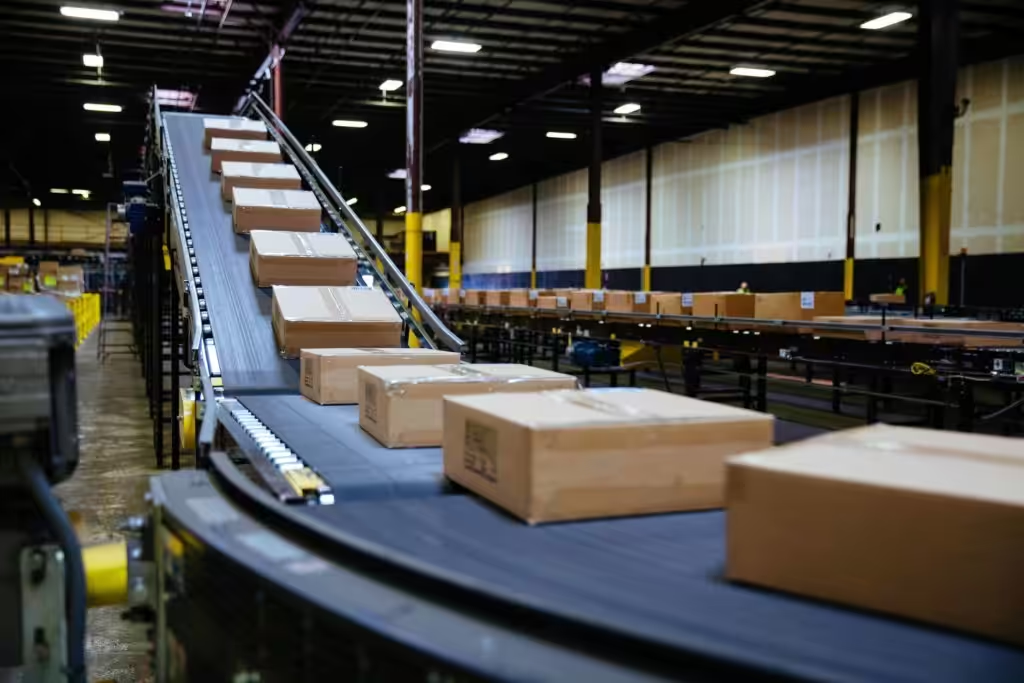
The problem: a technician can only lock what they can find, reach, and trust. On older conveyor systems, one disconnect may feed sections that no longer match the drawings, or one main breaker may be the only isolation for a whole line.
The consequence: when the right lockout point is hard to identify or forces a much bigger shutdown than the job needs, people look for shortcuts. That’s when an e-stop becomes the “lock,” or one person’s lock covers a section with three people working on it.
The engineering answer: the controls designer decides most of this before the conveyor ships. The choices that help most:
- Isolation that matches how the conveyor is maintained. Group motors and disconnects so a technician can isolate the section they’re working on without dropping the whole sorter. Local lockable disconnects at motors, or clearly assigned branch breakers in the panel, both work if the procedure and labels match.
- Lockable devices everywhere energy enters. The 1990 rule requires isolating devices on new and substantially modified equipment to accept a lock. That includes the air supply, not only the electrical feeds.
- Labels that tie the field to the drawings. Label each disconnect and breaker with the conveyor section it feeds, using the same names that appear on the HMI and in the electrical drawings.
- Drawings that stay current. Panel layouts, motor power wiring, and field wiring diagrams are the source documents for machine-specific procedures. After every modification, update both.
- Safety circuits designed for the layout. E-stops and pull cords should stop the zones a person can reach from that spot. This doesn’t replace lockout tagout, but it shapes how a facility stops a line safely before isolating it.
- Diagnostics before doors. When the HMI shows which photo eye is blocked, which motor faulted, and which zone is in alarm, technicians go to the right place and isolate the right section the first time.
- Remote support. Many control faults can be diagnosed by connecting to the PLC remotely, before anyone opens a panel or reaches into a conveyor.
Conveyor control panels and field wiring are also governed by electrical standards. LaFayette Engineering’s guide to NFPA 79 for conveyor controls explains how that standard shapes disconnecting means, panel layout, and field wiring. ASME’s B20.1 Safety Standard for Conveyors and Related Equipment is the conveyor-specific consensus standard many facilities reference for guarding, controls, and maintenance practices. Both are licensed standards, and this article describes them only at a high level.
Common Lockout Tagout Gaps on Conveyor Systems
These are the gaps that show up most often when a facility reviews its conveyor procedures:
- One generic procedure for the whole system. OSHA expects procedures that clearly and specifically outline the steps for the machine. A 400-foot sorter with three panels and pneumatic diverts needs more than “turn off the main.”
- Jam clearing treated as production work. Clearing a jam is servicing unless it’s covered by the minor servicing exception with an effective alternative measure.
- Air left out. The procedure covers the 480-volt feed but not the divert or brake air.
- Verification skipped. Nobody tries the local start, the HMI start, or the automatic restart condition after locking out.
- Drawings and labels out of date. A conveyor expansion added a VFD panel, but the procedure and the disconnect labels weren’t updated.
- Contractors on a different program. When an outside contractor services the conveyor, OSHA requires the facility and the contractor to inform each other of their energy control procedures.
- Shift changes. A job that spans shifts needs a planned handoff of lockout protection between the off-going and oncoming workers.
- The annual inspection is a signature. The periodic inspection is meant to watch an authorized employee perform the procedure and correct what’s found.
A Leadership Checklist
Use these questions with your maintenance and safety leads:
- Does every conveyor section have a written, machine-specific lockout tagout procedure that lists every energy source, including air and gravity?
- Can a technician find the correct isolation points for a section in under a minute from the labels and drawings?
- Can a single section be isolated without shutting down the entire system?
- Are jam-clearing tasks covered by lockout tagout or by a documented alternative measure that meets the minor servicing exception?
- Do procedures require trying every start point, including PLC automatic restarts, during verification?
- Were procedures, labels, and drawings updated after the last conveyor modification?
- When was each procedure last inspected in the field, and what changed as a result?
- How do outside contractors and integrators coordinate their lockout with yours?
How LaFayette Engineering Fits
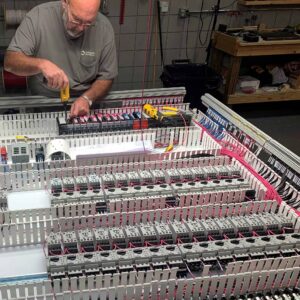
LaFayette Engineering designs and installs controls for conveyor systems, including high-speed case sortation. Its control panel design and fabrication is in-house, from small push-button enclosures to large motor control panels, and each panel is tested before it ships and labeled and documented to explain the system’s architecture and function. The controls package includes AutoCAD Electrical drawings with panel layouts, motor power wiring, schematics, I/O schematics, and field wiring diagrams, which are the documents a facility’s machine-specific procedures should be built from. LEI’s electrical installation team of qualified technicians and electricians installs to applicable codes and standards.
For lockout tagout, LEI’s role is to deliver conveyor controls whose isolation points, labels, and drawings make your energy control program practical to follow, and to keep that documentation current when the system changes. The program itself, including the procedures, training, and annual inspections, belongs to the employer.
This article is general information, not engineering, legal, or safety advice. OSHA’s rules, your facility’s energy control program, and the current editions of the cited standards govern your site.
Frequently Asked Questions
What is lockout tagout on a conveyor?
Lockout tagout on a conveyor is the procedure for isolating every energy source that feeds the section being serviced, locking those isolating devices in the off position, relieving stored energy, and verifying the section can’t start before anyone works on it. OSHA’s rule is 29 CFR 1910.147.
What are the lockout tagout steps?
OSHA’s sequence is: prepare for shutdown, shut the equipment down, isolate every energy source, apply locks and tags, relieve stored energy, and verify isolation. Release from lockout follows its own steps: inspect the area, confirm everyone is clear, notify affected employees, and have each person remove their own lock.
Is pressing an emergency stop the same as lockout?
No. OSHA states that push buttons, selector switches, and other control circuit devices are not energy isolating devices. An e-stop or pull cord stops motion in an emergency, but it doesn’t physically separate the conveyor from its power and can be reset by someone else.
Does clearing a conveyor jam require lockout tagout?
Usually, yes. OSHA’s definition of servicing includes unjamming. Minor servicing during normal production is excluded only when it’s routine, repetitive, integral to production, and performed with alternative measures that provide effective protection.
What stored energy remains on a conveyor after lockout?
Common sources are gravity on inclines and declines, backed-up product on accumulation lines, belt tension, compressed air in diverts and brakes, springs and counterweights, and the electrical charge held in VFDs after power is removed. Each needs a step in the procedure to relieve or block it.
Who can remove a lockout device?
Each lockout or tagout device must be removed by the employee who applied it. OSHA allows an exception only under a specific employer procedure for when that employee isn’t at the facility, which includes verifying they’re gone and making sure they know before returning to work.
How often must lockout tagout procedures be inspected?
OSHA requires the employer to inspect each energy control procedure at least annually. The inspection is done by an authorized employee other than the ones using the procedure, and it should correct any deviations it finds.
Do new conveyors need lockable disconnects?
Since January 2, 1990, OSHA has required that energy isolating devices on new equipment, and on equipment that undergoes major repair, renovation, or modification, be designed to accept a lockout device. That applies to air supplies as well as electrical disconnects.