A short circuit current rating (SCCR) is the maximum fault current a control panel or component can safely withstand at its rated voltage, measured in amperes. For a conveyor control panel, the short circuit current rating must be equal to or greater than the fault current available where the panel connects to the building’s electrical system.
If the panel’s rating is lower than the available fault current, a short circuit can do far more than trip a breaker. Components can rupture, the enclosure can be damaged, and anyone standing in front of it is at risk. It’s also one of the first things an electrical inspector checks on the panel nameplate. This guide explains what a short circuit current rating means, how it’s determined, why conveyor panels often come up short, and the steps that get it right before the panel ships.
At a glance
- A short circuit current rating tells you how much fault current a panel can survive. Available fault current tells you how much the building can deliver. The first number must meet or exceed the second.
- The NEC requires industrial control panels to be marked with their SCCR, and it prohibits installing a panel where the available fault current exceeds it. NFPA 79 also calls for SCCR on the machine nameplate.
- A panel’s short circuit current rating is usually set by its weakest power circuit component, unless current-limiting protection upstream raises it.
- Conveyor panels carry many motor branch circuits and drives, which gives them many places for a low rating to hide.
- The fix is cheapest during design. Ask for the available fault current before the panel is engineered.
Table of Contents
What Short Circuit Current Rating Means
The problem: “rating” shows up everywhere on electrical equipment: voltage, amps, horsepower, interrupting rating, and short circuit current rating. They answer different questions, and confusing them leads to panels that pass a shop test and fail an inspection.
The engineering answer: the short circuit current rating answers one question. If a bolted fault happens downstream of this panel’s supply, can the panel and its components withstand the resulting current until the protective device clears it, without the damage going beyond defined limits? The rating is expressed in symmetrical RMS amperes at a stated voltage, for example 65 kA at 480 V. It applies to the whole assembly, not only to its breakers or fuses.
Two terms sit next to it:
- Available fault current is how much current the building’s electrical system can deliver to a point during a short circuit. It depends on the utility transformer, the service equipment, the feeder length and size, and other sources such as motors. It’s a property of the location, not of the panel.
- Interrupting rating is the maximum current a breaker or fuse can safely open. OSHA’s electrical rule, 29 CFR 1910.303(b)(4), requires equipment intended to interrupt fault current to have an interrupting rating sufficient for the voltage and the current available at its line terminals.
Interrupting rating applies to the devices that open the circuit. Short circuit current rating applies to everything else in the path, including contactors, overload relays, motor protectors, terminal blocks, power distribution blocks, and drives, and to the panel as an assembly. OSHA’s next paragraph, 1910.303(b)(5), ties them together: overcurrent devices, circuit impedance, and component short-circuit current ratings have to be selected and coordinated so a fault clears without extensive damage to the circuit.
Why Short Circuit Current Rating Matters to Operations
The problem: short circuit current rating is easy to treat as a line on a nameplate that only the inspector reads.
The consequence: when the rating falls short, the costs land on operations. A panel installed where available fault current exceeds its rating can fail violently during a fault, damaging the panel and the equipment around it. That turns a breaker trip into a rebuild and a long outage on the conveyor it controls. A mismatch caught at inspection can hold up start-up while components are swapped or protection is redesigned, sometimes days before a facility needs to ship. And a mismatch nobody catches stays as a hidden risk until a fault finds it.
The engineering answer: treat short circuit current rating as a design requirement, set from the building’s available fault current at the start of the project. It should be on the panel specification alongside voltage, enclosure type, and I/O count.
What the Codes Require
The problem: short circuit current rating requirements live in several documents, and responsibility for them is split between the panel builder, the installer, and the facility.
The engineering answer: at a high level, these are the requirements leaders should know. The NEC (NFPA 70) and NFPA 79 are licensed standards, and the edition your authority having jurisdiction enforces governs your site.
- Marking. NEC Article 409 requires industrial control panels to be marked with their short circuit current rating, determined from a listed and labeled assembly or an approved method. UL 508A Supplement SB is the method most panel shops use.
- Installation. Article 409 also says a panel can’t be installed where the available fault current exceeds its short circuit current rating, and recent editions require the available fault current, and the date it was calculated, to be documented and available to the inspector.
- Service equipment. NEC 110.24 requires available fault current to be marked at service equipment in facilities other than dwelling units, with the date of the calculation, and updated when modifications change it.
- Machinery. For industrial machinery, NEC Article 670 and NFPA 79 call for the short circuit current rating on the machine nameplate. LEI’s guide to NFPA 79 for conveyor controls explains how that standard shapes panel and field wiring.
- OSHA. 29 CFR 1910.303(b)(4) and (b)(5) set the federal requirements for interrupting ratings and for coordinating protective devices with component short-circuit current ratings.
The practical result: the panel builder determines and marks the rating, and the facility and installer confirm it’s adequate for the location where the panel is installed.
How a Panel’s Short Circuit Current Rating Is Determined
The problem: a panel is built from dozens of components, each with its own rating, or with none marked at all. Somebody has to turn that collection into one number.
The engineering answer: UL 508A Supplement SB lays out the most common method. At a high level, it works like this:
- Identify the power circuit. The rating is based on the components in the power path (feeder and branch circuits), not on low-voltage control circuits that are isolated or protected separately.
- Find each component’s rating. Use the rating marked on the component or published by the manufacturer. Components with no marked rating get a default value from the standard, and those defaults are low.
- Apply the weakest link. In general, the lowest-rated component in the power circuit sets the panel’s short circuit current rating.
- Account for current limiting. A listed current-limiting device upstream, such as certain fuses or circuit breakers, can reduce the fault current that reaches downstream components. Under the method’s rules, that can raise the rating of the branch circuits it protects.
- Account for voltage and grounding. Some devices carry slash voltage ratings, such as 480Y/277 V, which apply only on solidly grounded wye systems. Those devices can’t carry the same rating on a delta or resistance-grounded system.
Manufacturers also publish tested combinations, such as a specific breaker or fuse class paired with a specific contactor and overload relay, that carry high ratings together. Using the tested combination as listed, with the exact protective device named, is one of the most direct ways to reach a high short circuit current rating.

Why Conveyor Panels Often Come Up Short
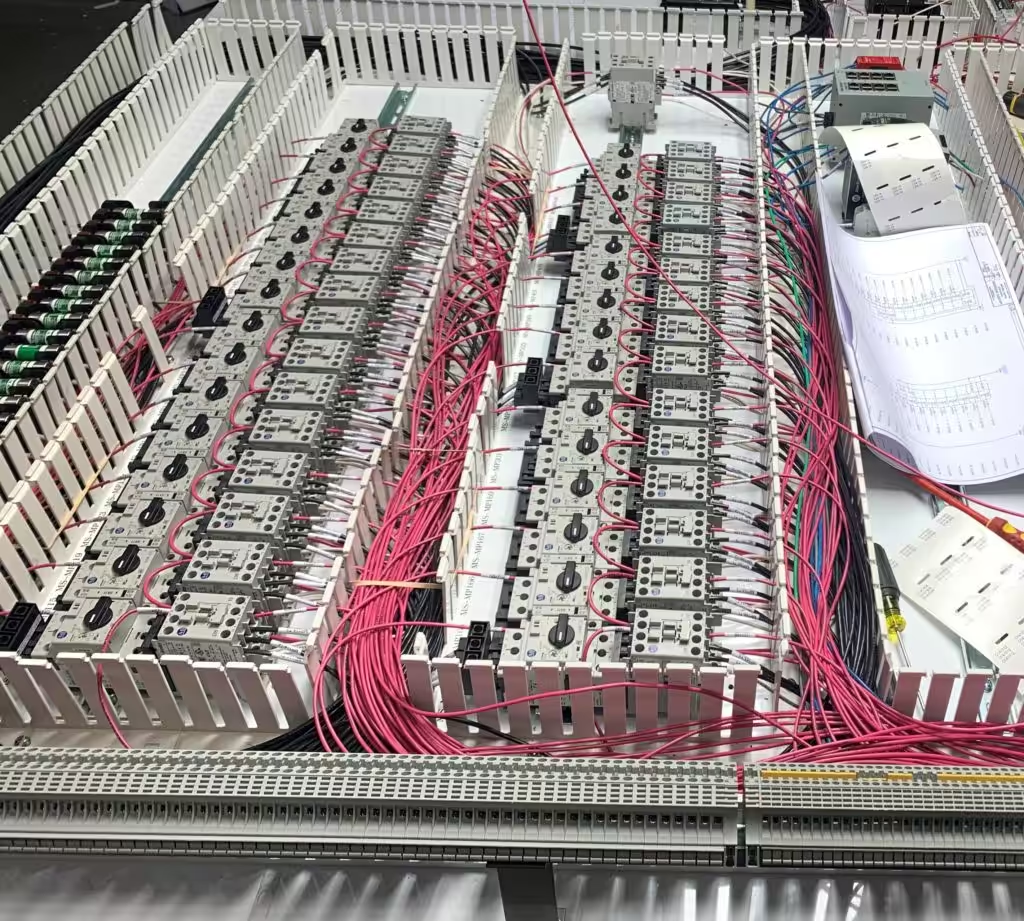
The problem: conveyor control panels are dense with power circuits. A single motor control panel can feed dozens of conveyor motors, each with its own branch protection, contactor or motor protector, and overload, plus VFDs, a control transformer, and power distribution blocks.
The consequence: every one of those power circuit components is a chance for a low rating. These are the usual suspects:
- Unmarked or low-rated components. A power distribution block, terminal block, or relay with no marked short circuit current rating gets a low default and pulls the whole panel down.
- VFDs with the wrong protection. Drive manufacturers publish high ratings only with specific fuse classes or breaker types. Substituting a different protective device can drop the drive’s rating sharply.
- Self-protected starters on the wrong system. Some combination motor controllers carry slash voltage ratings. On a 480 V delta or resistance-grounded system, they may not deliver the rating the drawings assume.
- Panels near the service. Available fault current is highest close to large service transformers. A panel that would be fine at the far end of a long feeder can be underrated when it’s installed next to the main switchboard.
- Changes after installation. A utility transformer upgrade, a new service, or added generation can raise available fault current at an existing panel. A rating that was adequate when the conveyor went in may not be adequate now.
- Field modifications. Adding a motor branch or swapping a component for whatever was on the shelf can change the panel’s rating without anyone recalculating it.

The 5-Step Process for Getting Short Circuit Current Rating Right
These steps keep short circuit current rating from becoming a start-up surprise.
1. Get the available fault current before design
Ask the facility’s electrical engineer or the utility for the available fault current at the point where each conveyor panel will connect, with the date it was calculated. If the panel’s location isn’t settled yet, use the value at the service or the feeding switchboard as a conservative starting point. This number belongs in the panel specification.
2. Set a target rating with margin
Choose a target short circuit current rating at or above the available fault current, with room for reasonable future change at the site. A rating that just clears today’s number leaves no margin for a utility upgrade.
3. Design the power circuit to the target
Select components, protective devices, and tested combinations that support the target rating. This is where the choice of fuse class or breaker type, the drive protection, the power distribution method, and the grounding system all matter. Designing to the number is far cheaper than replacing components after the panel is built.
4. Determine, mark, and document the rating
Calculate the panel’s short circuit current rating using a recognized method, mark it on the nameplate, and record the basis in the drawings and documentation: the components, the protective devices, the tested combinations, and the voltage and grounding assumptions. That record is what lets someone verify the rating later.
5. Recheck it when the system changes
Revisit the rating whenever the electrical system or the panel changes: a new service, a utility transformer change, an added motor branch, or a replacement component. Replacement parts should match the ratings and protective devices the original design depended on.
Raising a Panel’s Short Circuit Current Rating
The problem: sometimes the available fault current is higher than a standard panel design supports, or an existing panel turns out to be underrated.
The engineering answer: there are several ways to raise a short circuit current rating, and the right one depends on the panel and the site:
- Current-limiting fuses in the feeder or branch circuits, applied under the method’s rules, can let downstream components carry a higher rating.
- Higher-rated components replace the weakest links, such as power distribution blocks or relays with no marked rating.
- Manufacturer-tested combinations pair a specific protective device with a specific starter or drive at a published high rating.
- Correct drive protection means using the fuse class or breaker the drive manufacturer specifies for its high rating.
- Transformer impedance limits fault current on a transformer’s secondary side, which can protect lower-voltage circuits.
- Site changes such as relocating the panel or adding impedance upstream reduce the available fault current at the panel. These are larger projects and need an electrical engineer.
For an existing panel, the first step is an audit: compare the nameplate rating to the documented available fault current, then review the components and protective devices against the drawings. Any changes should be engineered and documented, and should go through the panel’s original listing or approval path where one applies.
How Short Circuit Current Rating Relates to Arc Flash
The problem: leaders hear “available fault current” in two conversations, panel ratings and arc flash, and assume one study covers both.
The engineering answer: they share an input but answer different questions. Short circuit current rating asks whether equipment can withstand the maximum fault. An arc flash assessment asks how much energy a person could be exposed to during an arcing fault, which depends on fault current, clearing time, and working distance. A short-circuit and coordination study often supplies the numbers for both. LEI’s article on arc flash labels on control panels explains how to read the labels that come out of that work.
Questions to Ask Your Panel Builder
Use these when you buy conveyor control panels or review existing ones:
- What short circuit current rating will the panel carry, and how was it determined?
- What available fault current did you design to, and where did that number come from?
- Which component or protective device limits the rating?
- Are the drive and starter ratings based on the manufacturer’s specified protective devices and tested combinations?
- Do any devices carry slash voltage ratings, and does our grounding system support them?
- Is the rating marked on the nameplate and documented in the drawings?
- Which replacement parts must match exactly to keep the rating valid?
How LaFayette Engineering Builds Control Panels
LaFayette Engineering designs and fabricates control panels in-house, from small push-button enclosures to large motor control panels for conveyor and high-speed sortation systems. Panels are built to industry or customer specifications, and each one is tested by LEI’s in-house electrical engineering team before it ships. LEI labels and documents its panels so the system’s architecture and function are clear, and its controls package includes AutoCAD Electrical drawings with panel layouts and bill of materials, motor power wiring, and electrical schematics.
Components come from recognized manufacturers, so replacement parts are available locally, which matters when a replacement has to match the rating the design depends on. LEI’s electrical installation team installs to applicable codes and standards.
If you’re specifying conveyor control panels or reviewing the ratings on panels you already own, LEI’s control panel design and fabrication team can talk through your requirements.
This article is general information, not engineering or legal advice. The NEC, NFPA 79, UL 508A, and your authority having jurisdiction govern your installation; confirm ratings and available fault current with a qualified electrical engineer.
Frequently Asked Questions
What is short circuit current rating?
Short circuit current rating (SCCR) is the maximum fault current, in symmetrical RMS amperes at a stated voltage, that a component or assembly such as a control panel can withstand without damage beyond defined limits. It must be equal to or greater than the available fault current where the equipment is installed.
What is the difference between SCCR and interrupting rating?
Interrupting rating applies to breakers and fuses and describes the maximum current they can safely open. Short circuit current rating applies to components and assemblies in the fault path, including contactors, overloads, and drives, and to the panel as a whole. Both must meet the available fault current.
How is a control panel’s short circuit current rating calculated?
The most common method, UL 508A Supplement SB, identifies each power circuit component’s rating, applies the lowest rating as the panel’s rating, and allows the rating to be raised where listed current-limiting devices or tested combinations protect downstream components.
Where is short circuit current rating marked?
On the nameplate of the industrial control panel or machine. The NEC requires it for industrial control panels and industrial machinery, and NFPA 79 includes it in the machine nameplate information.
What happens if available fault current exceeds the panel’s SCCR?
The installation doesn’t meet the NEC, and an inspector can reject it. More importantly, a fault could damage the panel and its components violently. The fix is to raise the panel’s rating, reduce the available fault current at the panel, or both, with engineering review.
Who is responsible for short circuit current rating?
The panel builder determines and marks the rating. The facility, its electrical engineer, and the installer are responsible for confirming the available fault current at the installation point and making sure the panel’s rating meets it.
Does short circuit current rating change over time?
The panel’s rating doesn’t change unless its components or protection change. Available fault current at the site can change, for example after a utility transformer upgrade or a new service, so a rating that was adequate at installation should be rechecked when the electrical system changes.
How can I raise the SCCR of an existing panel?
Common approaches are adding current-limiting fuses, replacing low-rated components, using manufacturer-tested combinations, and correcting drive protection. Each change should be engineered, documented, and handled through the panel’s listing or approval path where one applies.