A material handling integrator is the company that designs, builds, and brings together the conveyors, sortation, controls, and software in a distribution center or plant so they run as one system. Choosing a material handling integrator is a decision you’ll live with for the life of the equipment, because the integrator’s controls choices determine who can support the system, how fast it can be repaired, and what it costs to change later.
Most selection processes focus on the layout, the throughput model, and the price. Those matter. But the questions that separate a system you can own from one that owns you are usually about the controls: the PLC logic, the panels, the HMI, the warehouse control system (WCS), and the support behind them. This article gives operations and engineering leaders nine questions to ask any material handling integrator about controls, code ownership, documentation, and support, and explains why each answer matters after go-live.
At a glance
- The controls are where a conveyor system’s long-term cost and risk sit. Ask about them as carefully as you ask about the mechanical design.
- Find out who actually does the controls work for your material handling integrator. Many subcontract it.
- Open, non-proprietary components and programming make it possible to get parts and support from more than one source.
- Get a clear answer on who owns the PLC, HMI, and WCS code, and what you receive at handover.
- Documentation, testing, and start-up plans tell you how the integrator handles the hard parts of a project.
- Support terms should say exactly what’s covered, when, and how fast, and how remote access is secured.
Table of Contents
Why Controls Questions Decide the Integrator Choice
The problem: mechanical equipment is visible, and a buyer can compare one belt conveyor or shoe sorter to another. Controls are mostly invisible during the sale. A proposal may describe them in one line.
The consequence: after go-live, the controls decide nearly everything about daily operation. A sorter that jams because of a timing issue in the PLC logic, an HMI that shows a fault code but not where the fault is, or a WCS interface that drops cartons into the reject lane will cost more in missed ship windows than most mechanical problems. And when the original integrator is slow to respond, or the code is locked, the facility has few options.
The engineering answer: evaluate a material handling integrator’s controls capability as its own line item. Ask the nine questions below of every material handling integrator bidding on the project, and get the answers in writing as part of the scope.
LaFayette Engineering’s older post on choosing the right integration partner covers general due diligence such as references, site visits, and reviewing past work. This article goes deeper on the controls side.
1. Who Does the Controls Work, and Is It In-House?
Why it matters: a material handling integrator may design the layout and install the mechanical equipment, then subcontract the electrical engineering, panel building, PLC programming, and WCS to one or more controls firms. That’s common and can work well. The risk is in the seams: who is accountable when the sorter logic and the WCS disagree, and who answers the phone at 2 a.m.
What to ask:
- Which parts of the controls scope (electrical design, panel fabrication, PLC programming, HMI, WCS, field wiring, start-up) does your company perform, and which are subcontracted?
- If subcontracted, who is the controls firm, and will they also provide support after go-live?
- Who is the single point of accountability for controls performance?
Pairing a mechanical integrator with a dedicated controls partner is a normal model. On the Pitman Creek project, LaFayette Engineering took on the mechanical and electrical installation, electrical engineering, PLC controls, HMI, and warehouse control system, and worked with Hytrol integrator HOJ Engineering to hand the system over before the building’s opening. What matters is that the roles are clear before the contract is signed.
2. Which Platforms and Components Will You Use, and Are They Open?
Why it matters: some controls architectures rely on proprietary hardware or software that only the original supplier can program or replace. That can lock a facility into one vendor for parts, changes, and support for the life of the system.
What to ask:
- Which PLC platform, drives, network, and HMI software will you use? Why that platform for this project?
- Are any components, controllers, or software proprietary to your company or available only through you?
- Can a qualified controls engineer from another company read and modify the program with standard manufacturer tools?
- Are the components available from local distributors?
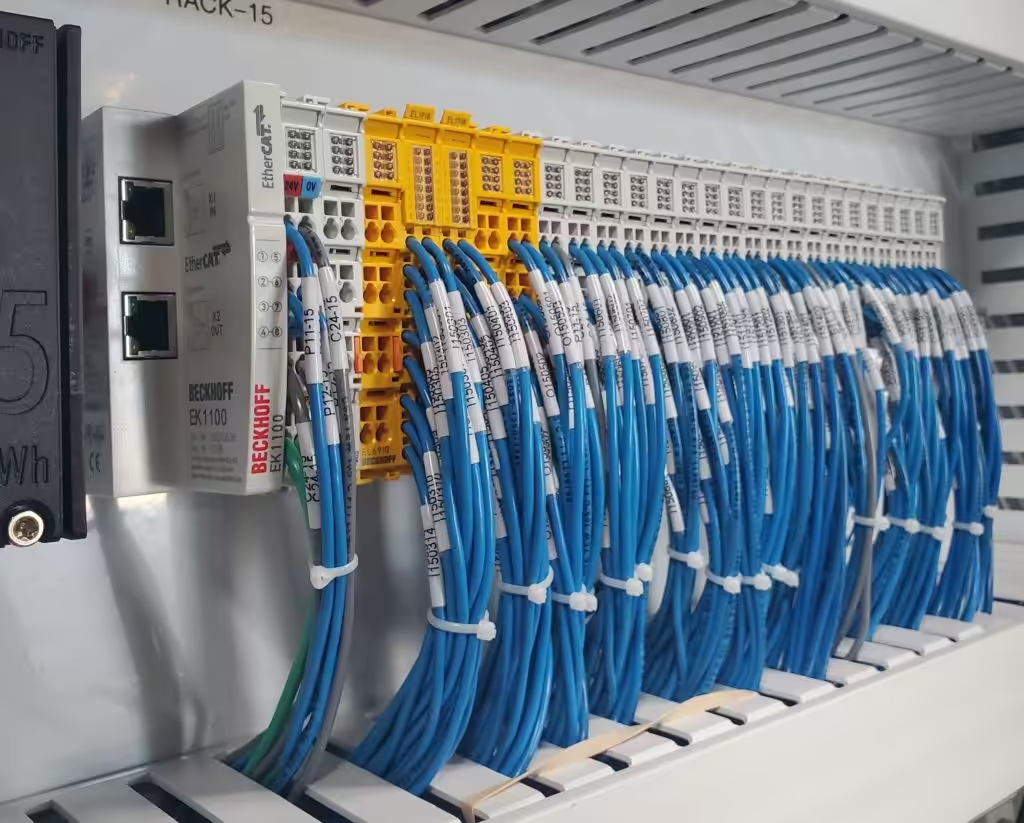
Standardizing on your site’s existing PLC platform, where it’s practical, makes spares and training simpler. LEI’s own controls practice is to use only open, non-proprietary components and programming architectures, with components from recognized manufacturers so spare parts are available locally. Whatever material handling integrator you choose, ask for the same clarity. LEI’s article on conveyor spare parts strategy explains why local availability matters when a line is down.
3. Who Owns the PLC, HMI, and WCS Code?
The problem: code ownership is often left vague in proposals. Some integrators deliver locked or password-protected PLC programs, provide compiled HMI runtime files without the source project, or license the WCS in a way that restricts changes.
The consequence: a locked program means every change, from adding a divert lane to adjusting a timer, has to go through the original material handling integrator, at their price and schedule. If that supplier is acquired, closes, or stops supporting the product, the facility may have to reverse-engineer or replace working controls.
What to ask:
- Will we receive the complete, unlocked PLC source program, with comments and tag descriptions, at handover?
- Will we receive the HMI source project files, not only the runtime?
- Who holds the passwords, and will we receive them?
- How is the WCS licensed? What can we change ourselves, and what requires you?
- What happens to our access to the code if your company is sold or stops supporting this product?
There’s a fair balance here. A material handling integrator may reasonably protect reusable software libraries or a commercial WCS product, and may limit warranty coverage if the owner changes the code. Settle the terms before signing so nobody discovers them during an outage.
4. What Documentation Will We Receive?
Why it matters: documentation is how the next technician, the next material handling integrator, and your own maintenance team understand the system. Good drawings shorten every repair. Missing drawings lengthen every repair and make safe maintenance harder.
What to ask:
- Will you provide electrical drawings (panel layouts, schematics, motor power wiring, I/O schematics, field wiring diagrams) as built, in an editable format?
- Will you provide a bill of materials and a recommended spare parts list?
- Will you provide operation and maintenance manuals for the equipment?
- How will drawings and programs be updated if the system changes during or after the project?
As a reference point, LEI’s published controls process produces AutoCAD Electrical drawings that include panel layouts with a bill of material, motor power wiring, electrical schematics, I/O schematics, and field wiring diagrams. LEI’s project management practice generates a spare parts list and a manual for all unit machines when the system is delivered.
5. How Will the WCS Connect to Our WMS?
The problem: the interface between the warehouse management system and the warehouse control system is where many projects slip. The WMS knows the order; the WCS and PLC know where the carton is. When the two disagree, cartons go to the wrong lane, the reject lane, or nowhere.
What to ask:
- Will you provide the WCS, or interface with one we already have?
- What messages pass between the WMS and the WCS, in what format, and who writes the interface specification?
- Who tests the interface, and when? Against a test WMS or the live one?
- What happens on the floor when the WMS is down or slow? Does the sorter keep running, and where do cartons go?
- How are routing exceptions (no read, no data, full lane) handled and reported?
A material handling integrator should be able to walk you through the exception paths, not only the happy path. LEI’s warehouse control system, ConveyorWorks, provides real-time routing and interfaces with the WMS for routing information.
6. How Will the System Be Tested Before It Reaches the Floor?
Why it matters: every problem a material handling integrator finds in the panel shop or in a simulation is a problem that doesn’t happen during start-up, when the building is waiting to ship.
What to ask:
- Are control panels tested before they ship? What does that test include?
- Is the PLC logic tested before installation, with emulation or a factory acceptance test? Can we attend?
- What is the commissioning plan: I/O checkout, motor rotation, photo eye and scanner tests, then product testing at increasing rates?
- What acceptance criteria will we sign off against, and how are they measured?
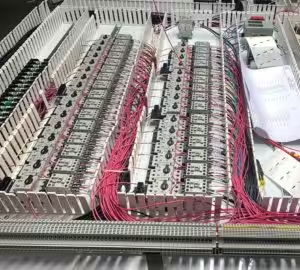
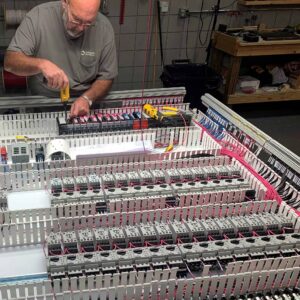
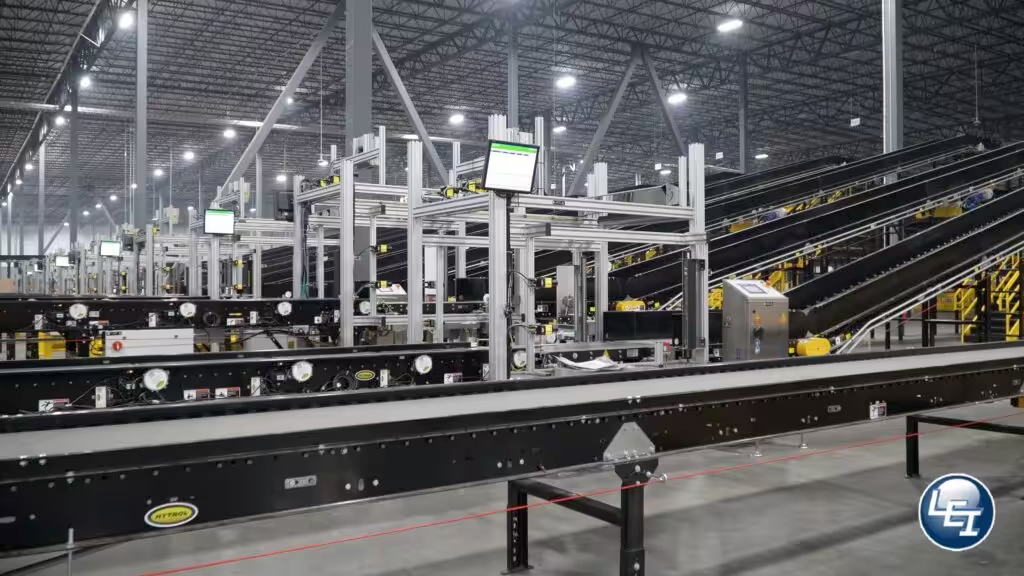
LEI builds its control panels in-house and its electrical engineering team tests each one before it ships.
7. What Does Start-Up Look Like, and Who Stays On Site?
The problem: start-up is when design meets real product. Cartons are softer, polybags are slicker, labels are worse, and volumes ramp faster than anyone planned. A system can pass its tests and still struggle in its first peak.
The consequence: a material handling integrator whose controls team leaves the day the system passes acceptance leaves you to solve the first month’s problems alone. A project timed to open before peak has no slack.
What to ask:
- Who from your controls team will be on site during start-up, and for how long after go-live?
- How are punch list items recorded, tracked, and closed?
- How will our operators and maintenance staff be trained, and on what?
- What’s the plan if go-live lands close to our peak season?
LEI’s published controls process includes installation coordination, punch list development and tracking, launch assistance with start-up support at the customer’s facility, and ongoing service and support.
8. What Support Do You Provide After Go-Live?
The problem: “24/7 support” means very different things from one material handling integrator contract to the next. It might mean a voicemail box, a call center, or an engineer who can connect to the PLC within minutes.
What to ask:
- What support levels do you offer (warranty, business hours, extended), and exactly what does each cover?
- What hours, including holidays?
- How do after-hours calls reach an engineer, and how fast does someone respond?
- Can your team connect to the PLC remotely? How is that remote access secured, and who controls it?
- Who on your team actually knows this system, and what happens when they’re unavailable?
Remote access is worth a separate conversation with your IT and security leads. It speeds up troubleshooting, and it’s also a path into your control network. CISA’s industrial control systems guidance and the ISA/IEC 62443 series are common references for securing that access. LEI’s article on PLC security for warehouses and DCs covers the practical side.
For a concrete example of support terms written plainly, LEI’s support page defines three levels: warranty support around the clock for the area of new work, normal support Monday through Friday from 8 a.m. to 5 p.m. Eastern, and extended support 24 hours a day, 365 days a year, including holidays. Support is by phone or by a direct connection to the PLC over a customer-provided VPN, and after hours a call center takes the details and relays them to the on-call person, who calls back.
9. How Will You Support the System Over Its Lifecycle?
The problem: a conveyor system often runs for well over a decade. The PLCs, drives, HMIs, and computers in it won’t. Manufacturers move products to mature status, then end of life, on their own schedule.
The consequence: a facility that doesn’t plan for it finds out a part is discontinued when one fails. A material handling integrator that installed the system and then disappeared leaves that problem with you.
What to ask:
- Will you help us track the lifecycle status of the controls hardware and software in this system?
- Do you offer preventative maintenance or lifecycle planning?
- When a controller or drive family reaches end of life, how do you approach migration?
- Can you support systems your company didn’t install, if we expand or consolidate sites later?
LEI’s article on end of life vs. active mature explains how to read manufacturer lifecycle notices and when to act on them. LEI’s support offering includes lifecycle schedules and preventative maintenance plans.

Material Handling Integrator vs. Controls Partner: Which Model Fits?
There are two common ways to buy a conveyor system:
| Model | How it works | What to watch |
|---|---|---|
| Single turnkey material handling integrator | One company is responsible for mechanical, controls, software, installation, and support | Ask which parts they perform themselves and which they subcontract |
| Mechanical integrator plus controls partner | A mechanical integrator or equipment supplier delivers the conveyor; a controls firm delivers panels, PLC, HMI, WCS, and support | Define the interfaces, the accountability, and who supports what after go-live |
Neither way of buying from a material handling integrator is better in every case. A conveyor system integrator with strong in-house controls can simplify accountability. A dedicated controls partner can bring deep PLC, sortation, and WCS experience to a mechanical integrator’s project, or take over support of an existing system. The nine questions apply either way.
A Scoring Checklist for Your Selection Team
Ask each material handling integrator to answer in writing, then score:
- Controls scope performed in-house versus subcontracted, with one accountable party named.
- Platforms and components named; no proprietary lock-in, or lock-in disclosed and justified.
- Code ownership: unlocked source, HMI projects, passwords, and WCS license terms stated.
- Documentation list, formats, and update process defined.
- WMS to WCS interface specification, test plan, and exception handling described.
- Panel testing and logic testing before site described, with attendance offered.
- Start-up staffing, punch list process, training, and post-go-live presence defined.
- Support levels, hours, response path, and remote access security spelled out.
- Lifecycle planning, preventative maintenance, and migration approach described.
A material handling integrator that answers all nine clearly is telling you how it will behave after the contract is signed.
How LaFayette Engineering Fits
LaFayette Engineering’s primary business is the design and installation of controls for conveyor systems, including high-speed case sortation. Its PLC controls work runs from needs assessment and conveyor concepts through AutoCAD Electrical drawings, in-house panel fabrication, PLC programming including sortation logic, project management, field installation, start-up support, and ongoing service. LEI works as the controls company on a project or alongside a mechanical integrator, and supports systems after go-live through warranty, normal, and extended support.
If you’re comparing material handling integrator bids, LEI is glad to talk through the controls side of your project. This article is general information, not legal or contracting advice; have your own counsel review code ownership, licensing, and warranty terms in any integrator agreement.
Frequently Asked Questions
What does a material handling integrator do?
A material handling integrator designs and brings together conveyors, sortation, controls, and software so they work as one system in a distribution center or plant. The scope often includes layout, equipment supply, electrical and controls design, installation, start-up, and support, though some parts may be subcontracted.
What should I ask a material handling integrator before signing?
Ask who performs the controls work, which platforms and components they’ll use, who owns the PLC, HMI, and WCS code, what documentation you’ll receive, how the WCS connects to your WMS, how the system is tested, who stays for start-up, what support covers, and how they handle lifecycle and migration.
Should we own the PLC code for our conveyor system?
Most owners benefit from receiving the complete, unlocked PLC program, HMI source files, and passwords at handover, so qualified engineers can maintain and modify the system. A material handling integrator may protect reusable libraries or commercial software products, so agree on the terms in writing before signing.
What is the difference between a material handling integrator and a controls integrator?
A material handling integrator typically takes responsibility for the overall system, including mechanical equipment. A controls integrator focuses on electrical design, control panels, PLC programming, HMI, and often the WCS. Some companies do both; others partner to cover the full scope.
Why do open, non-proprietary controls matter?
Open, non-proprietary controls use standard platforms and components that other qualified engineers can program and that local distributors stock. That keeps parts available and gives the owner more than one option for support and future changes.
What documentation should a conveyor system integrator provide?
Expect as-built electrical drawings (panel layouts, schematics, motor power wiring, I/O schematics, and field wiring diagrams), a bill of materials, a recommended spare parts list, operation and maintenance manuals, and current copies of the PLC and HMI programs.
What does 24/7 support from a material handling integrator usually include?
It varies. Ask what’s covered, how after-hours calls reach an engineer, how quickly they respond, whether holidays are included, and whether the team can connect to the PLC remotely. Get the terms in writing rather than relying on the phrase “24/7.”
Can a different material handling integrator support a system someone else installed?
Often, yes, if the controls use standard platforms and the owner has the unlocked programs and current drawings. Proprietary components, locked code, or missing documentation make a takeover slower and more expensive.